



A Humpback Whale next to Gil Island in the Great Bear Sea, BC Andrew S. Wright / WWF-Canada.
Marine Protected Areas (MPA) Day on August 1, celebrates the vital role of protected ocean spaces in conserving marine biodiversity, rebuilding fish populations, supporting coastal communities, and safeguarding the health of our oceans for future generations. Indigenous-led marine protected areas have become one of the world’s most significant conservation movements over the past two decades. While Canada has emerged as a global leader, countries including Australia, New Zealand, Brazil, Palau and other South Pacific islands have also established Indigenous-led or co-managed marine protected areas. These initiatives combine Indigenous laws, governance systems, Traditional Ecological Knowledge (TEK), and Western science to protect biodiversity, while supporting Indigenous rights, cultures, and sustainable livelihoods. In Canada, the Great Bear Sea initiative, Arctic Inuit-led marine protection, and Haida marine governance are frequently cited internationally as models for combining biodiversity conservation with Indigenous rights and self-determination.
What are Indigenous-led marine protected areas?
An Indigenous-led marine protected area is a marine area where Indigenous governments play the primary or shared role in identifying the area to be protected, designing conservation objectives and managing the area. Many are also designated as Indigenous Protected and Conserved Areas (IPCAs), which are managed according to Indigenous laws, knowledge, and governance systems. Although most IPCAs in Canada have been terrestrial so far, marine IPCAs are rapidly expanding.
Why Indigenous leadership matters

Source: https://www.ilinationhood.ca/
For thousands of years before European colonization, Indigenous Peoples managed marine ecosystems through:
- seasonal harvesting
- harvest limits
- protected spawning grounds
- sacred no-take areas
- sustainable shellfish management
- clam gardens
- intertidal habitat restoration
- traditional ecological monitoring
Modern marine conservation increasingly recognizes that Indigenous stewardship contributed to the long-term health of many marine ecosystems. Indigenous leadership is also tied to Canada’s commitments under the United Nations Declaration on the Rights of Indigenous Peoples (UNDRIP) and reconciliation efforts.
Canada’s marine conservation goals
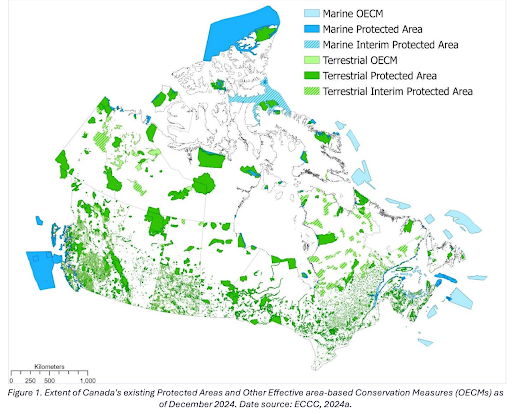
Canada has committed to conserving 30% of its oceans by 2030 (“30×30”).
As of May 2026:
- 17.65% of Canada’s marine and coastal areas are protected or conserved
- over 1 million km² are under conservation measures
- Indigenous partnerships are central to achieving the remaining conservation target.
Major Indigenous-led marine protected areas
- Great Bear Sea (Northern Shelf Bioregion)
Considered the ‘richest and most productive cold-water marine ecosystems on Earth’, The Great Bear Sea MPA Network is one of the world’s largest Indigenous-led marine conservation initiatives governed by 17 First Nations groups.
The network aims to:
- protect approximately 30% of the region
- recover salmon
- conserve whales and seabirds
- restore kelp forests
- improve fisheries sustainability

2. The Arctic’s Tuvaijuittuq MPA: The Last Ice Area

Tuvaijuittuq is Canada’s northernmost and largest MPA, approximately 319,000 km². For generations, Inuit have travelled through and harvested resources from this region, although there is no permanent settlement today, aside from the Canadian Forces station at Alert. Its name, meaning “the place where the ice never melts” in Inuktitut, reflects the area’s unique role as a refuge for some of the oldest and thickest sea ice in the Arctic Ocean. As climate change accelerates the loss of Arctic sea ice, scientists expect Tuvaijuittuq to be one of the last places where ice persists, earning it the nickname the “Last Ice Area.”
It was created through collaboration with Inuit organizations, and protects multi-year sea ice, polar bears, seals and Arctic cod. Multi-year sea ice is ice that survives the summer time, and provides stable habitat for species such as polar bears, seals, and algae (which form the base of the Arctic food web), that live within or beneath the ice. Protecting it involves addressing climate change, restricting commercial fishing, limiting industrial development, and protecting feeding and breeding grounds for Arctic wildlife. As sea ice disappears, more ships travel through the Arctic, protection from shipping routes can involve:
- Routing ships away from sensitive habitats.
- Limiting noise pollution.
- Reducing the risk of oil spills.
- Preventing black carbon (soot) emissions that settle on ice and make it absorb more sunlight, accelerating melting.
Other Arctic MPAs include: Sarvarjuaq Marine Protected Area, Qikiqtait Marine Protected Area, Anguniaqvia Niqiqyuam Marine Protected Area, and Tarium Niryutait Marine Protected Area.

Source: Fisheries and Oceans Canada, by Sophie Galarneau.
Deep Sea Mining Exploration Development
Interest in extracting resources from the Arctic deep sea has increased as demand grows for critical minerals such as nickel, cobalt, copper, and rare earth elements used in renewable energy technologies and electronics. However, unlike some regions of the Pacific where commercial deep-sea mining proposals are advancing, Canada has not approved commercial deep-sea mining operations in Arctic waters. Instead, current development has focused on expanding access to northern mineral deposits through infrastructure projects, including proposed Arctic ports and transportation corridors that could support future mining activities. In Nunavut’s Kitikmeot region, the proposed Grays Bay Road and Port project aims to connect remote mineral-rich areas to marine transportation routes, potentially unlocking access to copper and zinc resources. At the same time, scientists and conservation organizations continue to call for greater research and protection of Arctic deep-sea ecosystems, which remain among the least studied environments on Earth. Recent scientific expeditions exploring Arctic seamounts and deep-sea habitats have highlighted the discovery of previously undocumented species and the need to better understand these ecosystems before any large-scale extraction begins.
Indigenous Guardian Programs

120 People celebrate the guardians program in an Innu Shaputuan on Parliament Hill.
There are over 160 First Nations Guardians Programs in Canada’s MPAs who:
- patrol protected waters
- monitor whales
- collect scientific data
- document illegal fishing
- restore habitats
- educate visitors
- conduct archaeological monitoring
- respond to marine emergencies
Guardian programs blend Indigenous knowledge with modern technologies such as drones, GPS, and satellite imagery.
Traditional Ecological Knowledge (TEK)
TEK is increasingly integrated into management plans by incorporating:
- oral histories
- long-term ecological observations
- seasonal cycles
- Indigenous place names
- species behavior
- culturally significant habitats
This complements scientific monitoring and often extends ecological records far beyond modern scientific historical data.
Species benefiting
Indigenous-led marine protected areas safeguard numerous species, including:
- Porbeagle Shark, Basking Shark, Black Dogfish Shark
- Orcas
- Humpback whales, Gray whales, Fin whales
- Beluga whales, Narwhals
- Harbour porpoises
- Pacific salmon
- Herring, Rockfish
- Halibut, Lingcod
- Glass sponge reefs
- Giant Pacific octopus
- Sea otters, Steller sea lions
- Seabirds
- Polar bears
Conservation measures
Depending on the site, management may include:
- no-take zones
- restrictions on commercial fishing
- bans on bottom trawling
- protection from oil and gas development
- mining prohibitions
- shipping management
- anchoring restrictions
- vessel speed limits
- habitat restoration
- invasive species management
- long-term ecological monitoring
Many Indigenous-led MPAs allow sustainable Indigenous harvesting while limiting or prohibiting industrial activities that threaten biodiversity.
Global significance
Canada is setting a global benchmark for Indigenous-led marine conservation, proving that the most effective ocean protection is often led by the people who have cared for these waters for thousands of years. From the Great Bear Sea to Inuit-led initiatives in the Arctic and Haida marine governance on the Pacific coast, these partnerships are helping Canada achieve its goal of protecting 30% of its oceans by 2030 while advancing Indigenous rights and self-determination. At the same time, Indigenous Guardian programs are creating meaningful conservation careers, restoring marine biodiversity, rebuilding fisheries, strengthening climate resilience, and ensuring that traditional knowledge continues to guide the stewardship of Canada’s oceans for generations to come.
Author: Maggie Kendall


