


The African dwarf sawshark is a newly discovered species of sawshark found off the coast of Eastern Africa. The first specimen was discovered in Mozambique and belongs to the family Pristiophoridae.
Biology
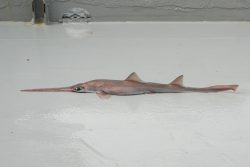
Like other sawsharks, it has a long snout with teeth that point outward. The rostrum is about a third of the shark’s total size. This species can be distinguished by its very large emerald-green eyes, two dark longitudinal stripes on the upper surface of the rostrum, and a broad triangular first dorsal fin. It has a brownish-gray coloration. Males reach maturity at 52–62 cm (20.4–24.4 in) total lenght, while females mature at approximately 57 cm (22.4 in). The maximum length is at least 62 cm (24.4 in).
Reproduction
The African Dwarf Sawshark is ovoviviparous, meaning embryos develop in eggs inside the mother’s body. Its size at birth, gestation period, generation length, and litter size are still unknown. However, the smallest specimen recorded measured 27 cm (10.6 in).
Habitat
These deepwater sharks live near the bottom at depths of 286 to 570 m (938–1,870 in), where they feed mostly on small crustaceans.They have a patchy distribution in the Western Indian Ocean with records from Mozambique, Yemen, and possibly Madagascar, Tanzania and Pakistan.
Conservation
The species was assessed as Least Concern on the IUCN Red List in 2018. Because it lives in deep waters where interactions with fisheries are limited, it is not currently considered to be at significant risk.
Do you have images or videos of African Dwarf Sawsharks?
Submit them to [email protected].


Donate Now | Team Sharkwater Newsletter | Group Sales | Shark Database | #SharkFree
Contact Us | Press | Partners | Terms of Use | Privacy Policy
© 2026 Sharkwater Productions - The Truth Will Surface 🦈