


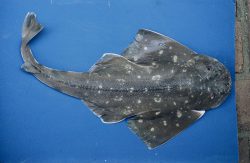
The Angular Angelshark, sometimes known as the Spiny Angelshark, lives in subtropical waters off the coast of Brazil, Uruguay and northern Argentina. They are endemic to this area and belong to the family Squatinidae.
Biology and Behaviour
Angular Angelsharks live on a diet of bony fish, crustaceans and molluscs. The species feeds at night and stays motionless on the seafloor during the day. When fully grown, these sharks reach a maximum size of 95 cm (37.4 in). Their generation length is 8 years, and they live up to 12 years old. Males and females both mature at 4 years old, at a total body length of 73–80 cm (29–31.5 in).
Reproduction
The Angular Angelshark produces between 3 and 9 pups in a litter, which measure approximately 25 cm (9.8 in) at birth. Their reproduction is ovoviviparous, which means the eggs are hatched inside the uterus where they remain until they are fully developed sharks. Females produce one litter every three years.
Habitat
Angular Angelsharks are demersal and usually found at depths between 10 and 80 m (33–262 ft).
Conservation
They’re currently classified as endangered by the IUCN. They’re particularly vulnerable to being caught due to the unregulated fishing in Brazilian waters and because pregnant females migrate to shallow waters to give birth. Their meat is sold for human consumption. In Brazil, the species is protected. Inshore trawling is prohibited, but the regulation lacks sufficient enforcement.
Do you have images or videos of Angular Angelsharks?
Submit them to [email protected].


Donate Now | Team Sharkwater Newsletter | Group Sales | Shark Database | #SharkFree
Contact Us | Press | Partners | Terms of Use | Privacy Policy
© 2026 Sharkwater Productions - The Truth Will Surface 🦈