


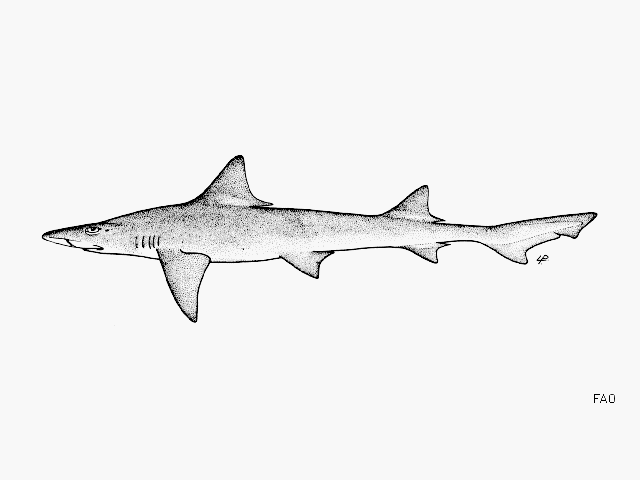
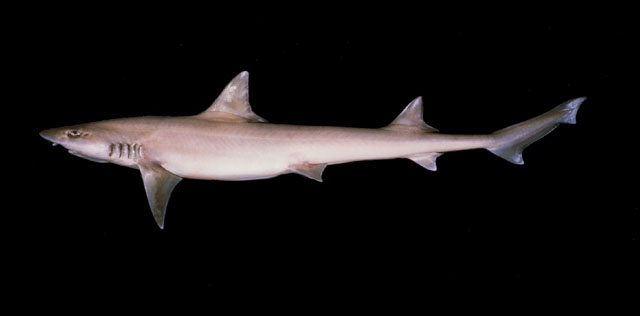
The Arabian Smoothhound is a small houndshark that lives in the Indian Ocean at depths between 20 and 250 m (66–820 ft). It occurs on the continental shelf inshore and offshore, and is sometimes associated with coral reefs. Its distribution extends from KwaZulu-Natal and Tanzania to the Red Sea, India and Sri Lanka.
Biology and Behaviour
Arabian smoothhounds typically have a white-tipped dorsal fin. Unlike other houndsharks that have spots along their body, Arabian smooth-hounds do not have any spots. They are benthic, living on the seafloor, and can be found in sandy, muddy and rocky areas.
Reproduction
Arabian Smoothhounds are viviparous. This means embryos develop inside an uterus and are nourished through a placental connection. Females give birth to between 2 and 16 pups per litter. The young Arabian smoothhounds are approximately 26–28 cm (10.2–11.0 in) long at birth. Males mature at about 65–78 cm (25.6–30.7 in) long, while females mature at 73 cm (28.7 in). The species can reach a maximum length of 150 cm (59.1 in), but individuals of over 100 cm (39.4 in) are rarely observed.
Conservation and Tourism
The species is caught in bottom trawls, gillnets and line gear throughout much of its range. Its meat is commonly sold for human consumption in local markets. The IUCN lists Arabian smooth-hounds as Near Threatened and its current population trend is decreasing. The genera Mutelus is listed in CITES Appendix II, meaning that Arabian smoothhounds can’t be exported without the appropriate permits.
Do you have images or videos of Arabian Smooth-hounds?
Submit them to [email protected].


Donate Now | Team Sharkwater Newsletter | Group Sales | Shark Database | #SharkFree
Contact Us | Press | Partners | Terms of Use | Privacy Policy
© 2026 Sharkwater Productions - The Truth Will Surface 🦈