


The Argentine Angelshark is endemic to the Southwest Atlantic. It can be found from southern Brazil all the way down to Buenos Aires in Argentina.
Biology and Behaviour
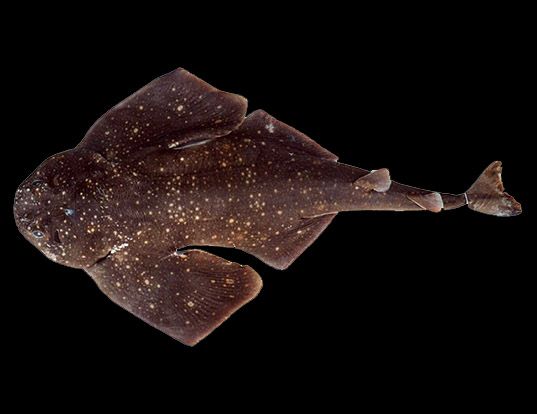
Like all Angelsharks, it has a wide, flattened body and large pectoral fins, which make it similar in appearance to a ray. The Argentine Angelfshark is a small species that can reach a maximum total length of approximately 138 cm (54.3 in). Both males and females reach maturity at about 120 cm (47.2 in) in length.
These bottom-dwelling sharks like to lie on soft substrates, especially sandy or muddy bottoms, and are usually found at depths between 51 and 320 m (167–1,050 ft). They are sit-and-wait predators, meaning that they remain motionless on the seafloor, hide in the sand and strike only when their prey comes within range. They feed mainly on fish, but also eat other prey such as shrimp and squid.
Reproduction and Lifespan
Argentine Angelsharks are ovoviviparous. This means that embryos develop inside eggs which hatch within the mother’s body. Females give birth to between 7 and 11 pups per litter, with 9 to 10 pups being most common. The reproductive cycle of a female lasts around two to three years.
Conservation
The Argentine Angelshark is classified as Critically Endangered on the IUCN Red List. Its main threats include bycatch and fishing pressure, particularly in demersal trawl and gillnet fisheries. The species is used for its meat, which is sold and consumed locally.
In Brazil, all three angelshark species occurring in the region were fully protected as of 2014 under Normative Instructions No. 5 and No. 445. This protection prohibits the intentional targeting, retention on board, and sale of the Argentine Angelshark in Brazil. However, illegal fishing, bycatch and lack of enforcement remain issues for the species’ conservation.
In the Argentina-Uruguay Common Fishing Zone, angelsharks are managed collectively through an annual total allowable catch for the genus Squatina.
Do you have images or videos of Argentine Angelsharks?
Submit them to [email protected].



Donate Now | Team Sharkwater Newsletter | Group Sales | Shark Database | #SharkFree
Contact Us | Press | Partners | Terms of Use | Privacy Policy
© 2026 Sharkwater Productions - The Truth Will Surface 🦈