


The Australian Angelshark is a common species endemic to southern Australia, found in the eastern Indian Ocean and southwest Pacific Ocean. Its population was monitored for 11 years, from 1994 to 2004, and showed a stable trend.
Description
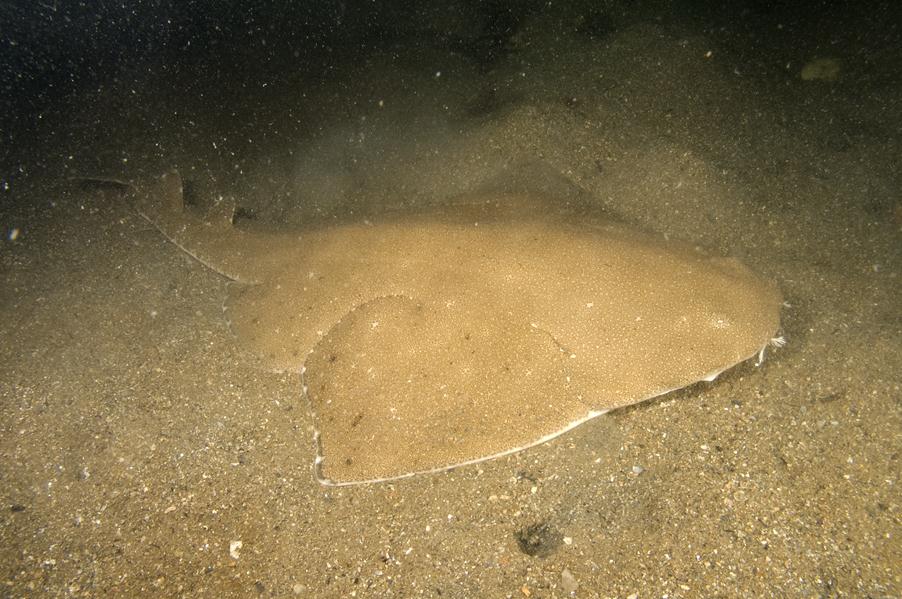
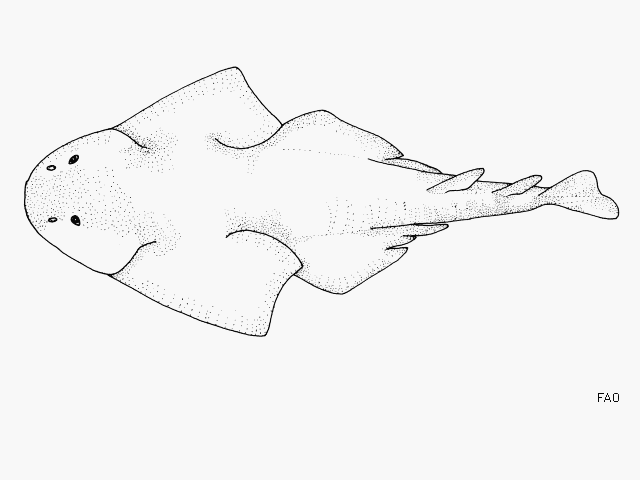
Australian angelsharks have a broad, vertically compressed body with large, triangular pectoral fins that extend forward from their bases on either side of the gill slits. They have dark spots on the lower lobe of their caudal fin, and their pelvic fins are enlarged and wing-like. Their snout has fringed barbels beside the nostrils and a pair of spiracles.
Biology and Behaviour
Australian angelsharks live in continental shelf waters at depths of up to 130 m (427 ft). They inhabit sandy and muddy surfaces, often in seagrass beds or near rocky reefs. They are demersal carnivores that spend much of the day buried in sandy bottoms, where they can capture prey that comes within reach. At night, they leave the sediments and actively search for food such as small fish, crustaceans and other invertebrates. The maximum recorded length for the species is 1.52 m (4.99 ft).
Reproduction and Lifespan
Australian angel sharks are ovoviviparous, meaning that eggs hatch inside the mother’s body and embryos feed on yolk. Females give birth during fall, with litters of up to 20 pups. Males mature at 90 cm (35.4 in) in length and can grow up to about 1.05 m (3.44 ft), while females mature at 97 cm (38.2 in) and can reach 1.15 m (3.77 ft).
Conservation and Tourism
The IUCN lists Australian angelsharks as Least Concern Two general management measures help conserve the species. The Southern and Eastern Scalefish and Shark Fishery was restructured in 2006 and 2007, resulting in reduced fishing effort and lower Total Allowable Catches (TACs). In addition, the management plan for the South-East Commonwealth Marine Reserves Network, which has been operational since 2013, restricts demersal otter trawling and Danish seining in 14 marine reserves, providing refuges for the species across much of its range.
Do you have images or videos of Australian Angelsharks?
Submit them to [email protected].


Donate Now | Team Sharkwater Newsletter | Group Sales | Shark Database | #SharkFree
Contact Us | Press | Partners | Terms of Use | Privacy Policy
© 2026 Sharkwater Productions - The Truth Will Surface 🦈