


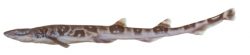
The Australian sawtail shark is a small catshark endemic to southern Australian waters. It lives at depths of 130 to 640 m (427–2,100 ft) and is found on or near the seafloor. Its distribution extends from southeastern Queensland to Western Australia, including the waters of New South Wales, Victoria, Tasmania, and South Australia.
Biology and Behaviour
These small sharks can reach a maximum length of 61 cm (24.0 in), but rarely grow to more than 60 cm (23.6 in). They are long and thin and their main characteristic is a series of tooth-like scales on their tails. They are light brown with about 12 dark saddles along their dorsal side and tail.
They feed on small bony fish, crustaceans, and cephalopods. They are also known to assemble in groups of the same sex. It is possible that females and males live at different depths, like other catshark species do.
Reproduction and Lifespan
They are oviparous and lay one egg at a time in each uterus. Females have only one functional ovary. Both males and females mature at about 40 cm (15.7 in) long. The eggs produced by females are about 7 x 9 x 2 cm (2.8 x 3.5 x 0.8 in).
Conservation
This species is abundant and is considered a species of Least Concern by the IUCN. Australian sawtail sharks are not specifically targeted by commercial fisheries, but are sometimes retained as byproduct. However, some populations are declining and must be monitored to prevent this shark to become threatened.
Do you have images or videos of Australian Sawtail Sharks?
Submit them to [email protected].


Donate Now | Team Sharkwater Newsletter | Group Sales | Shark Database | #SharkFree
Contact Us | Press | Partners | Terms of Use | Privacy Policy
© 2026 Sharkwater Productions - The Truth Will Surface 🦈