


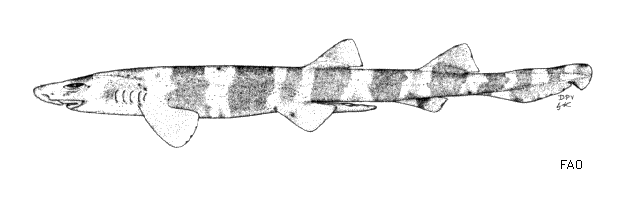
The Banded Catshark, also called the Banded Sand Catshark, is a shallow water shark found in the eastern Indian Ocean in Western Australia. It occurs at depths between 27 to 122 m (89–400 ft), with most records from depths shallower than 60 m (197 ft). The species is associated mainly with sandy and shelly benthic habitats.
Biology and Behaviour
They have black spots, a few small and scattered markings, and greyish saddles on a light background. The biology of the Banded Catshark is poorly known.
Reproduction and Lifespan
Banded catsharks are oviparous, which means they reproduce by laying eggs, usually in pairs. Males mature at about 33 cm (13.0 in) long, while females mature at a longer length of about 35 cm (13.8 in). The lifespan of the species is unknown.
Conservation and Tourism
The IUCN lists the Banded Catshark as Least Concern. There are no conservation methods in place that are specific to this species. However, all sharks and rays are commercially protected under the Western Australian law. Some areas of Western Australia’s North Coast Bioregion are also permanently closed to all trawling.
Do you have images or videos of Banded Catsharks?
Submit them to [email protected].



Donate Now | Team Sharkwater Newsletter | Group Sales | Shark Database | #SharkFree
Contact Us | Press | Partners | Terms of Use | Privacy Policy
© 2026 Sharkwater Productions - The Truth Will Surface 🦈