


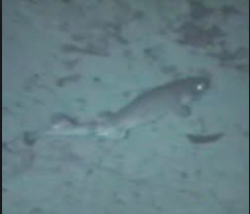
The Blackgill Catshark, formerly known as Parmaturus melanobranchus, was reclassified under the genus Dichichthys and is now known as Dichichthys melanobranchus. It is a small deep-water catshark found in the Northwest Pacific, off the coasts of China and Japan, at depths of 549 to 1,110 m (1,801–3,642 ft).
Like all members of the catshark family, it is a bottom feeder, with elongated cat-like eyes and two small dorsal fins set far back on its body. It is mostly nocturnal and often rests in groups during the day. Its diet consists of bony fishes, as well as bottom-dwelling crustaceans and cephalopods.
Very little is known about its biology as only a few specimens have been studied. The largest recorded specimen was 85 cm (33.5 in) long. The species is presumed to be oviparous, meaning that it reproduces by laying eggs.
The Blackgill Catshark may be caught as bycatch in some deep-water fisheries. The species was previously classified as Data Deficient by the IUCN, but its status was changed to Least Concern in 2020 because there is currently no evidence of a population decline. No specific conservation measures are currently in place for the species.
Do you have images or videos of Blackgill Catsharks?
Submit them to [email protected].


Donate Now | Team Sharkwater Newsletter | Group Sales | Shark Database | #SharkFree
Contact Us | Press | Partners | Terms of Use | Privacy Policy
© 2026 Sharkwater Productions - The Truth Will Surface 🦈