


The blackmouth catshark is an abundant species of ground shark from the Eastern Atlantic. It is found from the Faroe Islands and Norway to Senegal, including the Mediterranean Sea and the Black Sea. It usually lives at depths of about 200 to 500 m (656–1,640 ft), although it has also been recorded in waters from 55 to 2,000 m (180–6,562 ft).
Biology and Behaviour
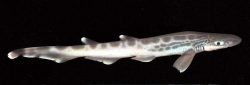
They are white and brown, with a marble pattern along their body and tail. The inside of its mouth is black, which gives the species its name. Adults are generally 50 to 80 cm (19.7–31.5 in) long, but the species can reach about 90 cm (35.4 in) in total length. Their diet consists mostly of small bony fish and crustaceans.
Reproduction
Blackmouth catsharks are oviparous, which means they lay eggs to reproduce. Females produce batches of 2 to 8 egg cases, although up to 13 egg cases can be laid in a litter.
In the Alboran Sea, males reach maturity at approximately 44.3 cm (17.4 in) in total length, while females mature at about 48.8 cm (19.2 in). The reproductive cycle appears to be continuous, with spawning occurring throughout the year.
Conservation
These sharks are reported as bycatch in deep-water demersal trawl, longline and trap fisheries across much of their range. They may be discarded, but the species is also used for human consumption and leather in some regions.
Blackmouth catsharks are considered common and abundant across much of their range. They are currently listed by the IUCN as a species of Least Concern because there is no evidence of a population decline.
Do you have images or videos of Blackmouth catsharks?
Submit them to [email protected].


Donate Now | Team Sharkwater Newsletter | Group Sales | Shark Database | #SharkFree
Contact Us | Press | Partners | Terms of Use | Privacy Policy
© 2026 Sharkwater Productions - The Truth Will Surface 🦈