


Grey Reef Sharks, also called Blacktail Reef Sharks, can be spotted in many places around the world as their range is widespread. They occur in the central Pacific Ocean and west onwards to the eastern Indian Ocean, from the surface to depths of at least 280 m (919 ft), usually near coral reefs.
Biology and Behaviour
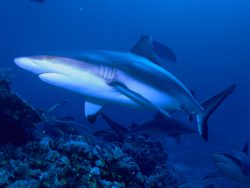
Grey reef sharks are dark grey to bronze-grey with an off-white underside. They have a stout body, a broad, round snout and large eyes. Their upper and lower jaws each have 13 to 14 teeth. They have a long black margin along the entire posterior edge of their caudal fin. Their dorsal fin may have a white edge, their second dorsal, anal, pectoral and pelvic fins have dusky or black tips.
Although they are active during the day, they are even more active at night. During the day, they can form schools near their favorite areas, but at night these groups disperse and the sharks hunt alone. They are fast swimmers and show strong site fidelity. They feed mainly on bony fish, but sometimes will prey on squids, octopuses and crustaceans. When they feel threatened, they can perform a threat display that involves arching their back, lowering their pectoral fins and swimming with an exaggerated movement as a warning sign.
Reproduction and Lifespan
Grey reef sharks are viviparous, meaning that embryos develop inside a uterus and are nourished through a placenta. Females reproduce every other year with a gestation period of 12 to 14 months and a small litter of between one and six pups. The size at birth is between 48 to 49 cm (18.9–19.3 in).
Males mature between 110 to 145 cm (43.3–57.1 in) long and can grow up to 1.85 m (6.1 ft). Females mature at around 120 to 142 cm (47.2–55.9 in) and can attain a length of 1.9 m (6.2 ft). The maximum length reported was a male at 2.55 m (8.37 ft) long. Age at maturity is between 7 and 9 years for both males and females and the lifespan for grey reefs is believed to be about 25 years.
Conservation and Tourism
The IUCN lists grey reef sharks as Endangered because of significant population declines across their range. The species is used for their meat, liver and skin. Because they depend strongly on coral reef habitats, they are also vulnerable to climate change and coral reef degradation. In some important reef-diving sites, like in the Maldives, tourism has encouraged protective measures for Gray Reef Sharks. Grey reef sharks are also listed in CITES Appendix II along with every member of the Carcharinidae family. This means that their international trade is regulated and that they can’t be exported without permits.
Do you have images or videos of Grey Reef Sharks?
Submit them to [email protected].


Donate Now | Team Sharkwater Newsletter | Group Sales | Shark Database | #SharkFree
Contact Us | Press | Partners | Terms of Use | Privacy Policy
© 2026 Sharkwater Productions - The Truth Will Surface 🦈