


The Blackspot Shark, Carcharhinus sealei, is a small species of requiem shark in the family Carcharhinidae. It occurs in the eastern Indian Ocean and the western central Pacific Ocean, particularly around the Andaman and Nicobar Islands and the Indo-Malay Peninsula, from Myanmar to the Philippines.
Description
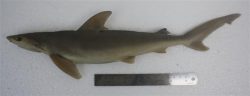
The Blackspot Shark is a relatively slender species with a streamlined appearance. The snout is fairly long, pointed, or slightly rounded at the tip. The eyes are large and oval, and they are set horizontally. They are protected by a nictitating membrane on the lower side.
The flaps of skin beside the nostrils are triangular, and the furrows on the upper lip are short. It usually has 12 tooth rows on either side of both the upper and lower jaws, although the number can vary from 11 to 13. The first dorsal fin is long, narrow, and curved, with a short rear tip. The second dorsal fin is relatively large.
The pectoral fins are falcate, long, and narrow, tapering to a blunt point. The caudal fin is about one-fifth of the shark’s total length. The body is brownish or silvery grey on the dorsal surface and pale grey on the ventral surface, with an inconspicuous pale stripe running along the flank.
Biology and Behaviour
This species feeds on small fish, crustaceans, and squid. Males reach maturity at approximately 70–80 cm (27.6–31.5 in) total length, while females mature at approximately 68–75 cm (26.8–29.5 in) total length. The maximum recorded size is about 95 cm (37.4 in) total length.
Reproduction
The reproductive mode of this species is viviparous, meaning that embryos develop inside the female’s and are nourished through a placental connection.The gestation period is about 9 months and the litter size is about one or two pups. Newborns measure about 33–36 cm (13.0–14.2 in) total length, and the species is presumed to have an annual reproductive cycle.
Habitat
The Blackspot Shark is native to the eastern Indian Ocean and the western central Pacific Ocean. It is found on continental and insular shelves, from the surface to depths of approximately 40 m (131 ft). It is not usually found in estuaries and may be intolerant of low-salinity water. Its confirmed distribution includes the Andaman and Nicobar Islands, Myanmar, Thailand, Cambodia, Vietnam, Malaysia, Brunei, Indonesia, and the Philippines.
Conservation
The Blackspot Shark is classified as Vulnerable by the IUCN. The species is caught as retained bycatch in artisanal, commercial, and small-scale fisheries. The Blackspot shark is a common catch in artisanal fisheries and small-scale commercial fisheries, as well as by recreational anglers. Its meat and fins are used, although its small size limits its commercial value in some areas.
Do you have images or videos of Blackspot Sharks?
Submit them to [email protected].


Donate Now | Team Sharkwater Newsletter | Group Sales | Shark Database | #SharkFree
Contact Us | Press | Partners | Terms of Use | Privacy Policy
© 2026 Sharkwater Productions - The Truth Will Surface 🦈