


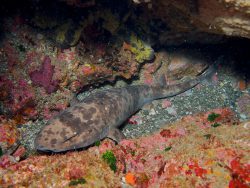
The Japanese Swellshark, also called the Blotchy Swellshark, is a deep-water catshark endemic to the Northwest Pacific. It is found in the Sea of Japan, the Yellow Sea, and the East China Sea, off the coasts of Japan, the Republic of Korea, China, and Taiwan. This species occurs on the continental shelf and upper slope, generally between 18 and 790 m (59–2,592 ft).
Biology and Behaviour
Their name comes from their ability to inflate their bodies with air or water to appear larger to predators. Like all catsharks, they are bottom feeders, have elongated cat-like eyes, and two small dorsal fins set far back on their body. They are mostly nocturnal and often sleep in groups during the day.
The species can reach about 114.5 cm (3.76 ft). Its diet consists of bony fishes and bottom-dwelling crustaceans and cephalopods.
Reproduction
The Japanese Swellshark is oviparous, meaning that females lay egg cases. Egg cases are laid throughout the year, and the size at hatching is approximately 18 cm (7.1 in) total length. The litter size remains unknown.
Males reach maturity at around 86 cm (33.9 in), while females mature at approximately 92 cm (36.2 in).
Conservation
The Japanese Swellshark is caught as bycatch in demersal trawl, longline, and possibly gillnet fisheries.
It is currently assessed as Near Threatened by the IUCN because it is exposed to ongoing fishing pressure. However, reliable population trend data are unavailable and further research and monitoring are needed.
Do you have images or videos of Japanese Swellsharks?
Submit them to [email protected].


Donate Now | Team Sharkwater Newsletter | Group Sales | Shark Database | #SharkFree
Contact Us | Press | Partners | Terms of Use | Privacy Policy
© 2026 Sharkwater Productions - The Truth Will Surface 🦈