


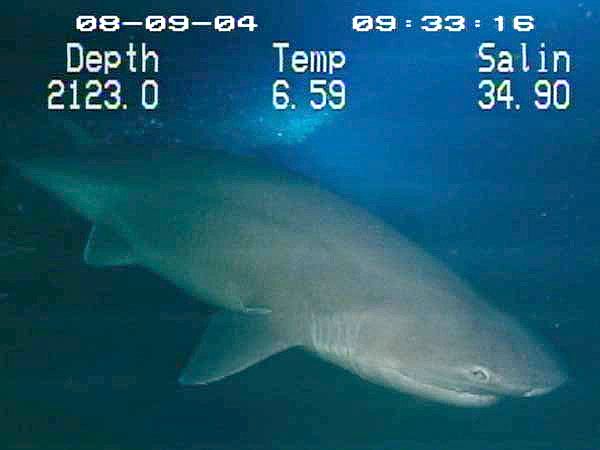
The bluntnose sixgill shark is a widely distributed species of cow shark. It is found in temperate, tropical and boreal waters around the continental shelves and upper slopes of the Atlantic, Indian and Pacific Oceans. It occurs from the surface to depths of approximately 2,490 m (8,169 ft), although it is most commonly found between 200 and 1,100 m (656–3,609 ft).
Biology and Behaviour
The Bluntnose Sixgill Shark feeds on a wide variety of animals, including other sharks, rays, dolphinfish, cod, flounders, hagfish, lampreys, chimaeras, squid and other cephalopods. The species generally feeds at night and is considered a generalist predator. No unprovoked attacks on humans have been reported.
Larger individuals have sometimes been reported to react negatively to intense light, this behaviour has not been conclusively established.
Habitat
Young bluntnose sixgill sharks tend to be found in relatively shallow coastal waters. As they grow, they generally move toward deeper areas. Adults often remain near the bottom during the day and may move toward shallower waters or closer to the surface at night to feed. The species is often observed alone, and relatively little is known about its migration.
Reproduction and Lifespan
This shark is an ovoviviparous species and. The embryos develop inside the female and hatch from their eggs before the young are released.Gestation period is estimated to last approximately 12 to 24 months, and females may reproduce every two years. At birth, the pups measure approximately 61–74 cm (24–29 in) in length. Males mature at approximately 3.09–3.30 m (10.1–10.8 ft), while females mature at 3.50–4.20 m (11.5–13.8 ft) and 26.5 years of age. Its maximum age has been estimated at about 80 years.
Conservation
The Bluntnose Sixgill Shark is classified as Near Threatened by the IUCN because of reported population declines and the effects of fishing pressure. Because the species matures late and has a long generation time, its recovery following population declines may be slow.
The species is caught as bycatch in deep-water fisheries using trawls, longlines, handlines, traps and gillnets. It is also targeted by some recreational fishers.
Conservation measures are inconsistent throughout its distribution. In Canada, the bluntnose sixgill shark has been listed as a species of Special Concern under the Species at Risk Act, and a management plan has been developed to support its conservation and recovery.
Do you have images or videos of Bluntnose Sixgill Sharks?
Submit them to [email protected].



Donate Now | Team Sharkwater Newsletter | Group Sales | Shark Database | #SharkFree
Contact Us | Press | Partners | Terms of Use | Privacy Policy
© 2026 Sharkwater Productions - The Truth Will Surface 🦈