


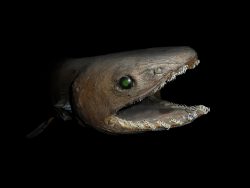
The Frilled Shark is a deep-water shark. It has been called a “living fossil” because of its similarity to prehistoric sharks. Its elongated body makes it look like a mix between an eel and a shark. Its name comes from the six pairs of gill slits that give its neck a frilled appearance.
Biology and Behaviour
The Frilled shark’s dark brownish body is well adapted for life in the deep sea. Its liver is very large and full of fats, which contributes to buoyancy and reduces the effort needed to maintain its position in the water column.
Its jaws are very flexible, allowing it to open its mouth widely to swallow big prey. Its numerous thin, curved teeth are very effective at catching soft prey such as squid. Males mature at between 92 and 163 cm (36.2–64.2 in), while females mature at around 130–135 cm (51.2–53.1 in). The species’ maximum length is 1.96 m (6.4 ft).
Reproduction
The frilled shark is ovoviviparous, which means that eggs hatch inside the female’s uterus and embryos are nourished from yolk. It has one of the longest gestation periods of all vertebrates with estimates ranging from one to 3.5 years. Litter sizes vary from two to fifteen, with an average of 6, and pups measure about 39 cm (15.4 in) long at birth.
Conservation
Frilled sharks are not usually targeted but are occasionally caught as bycatch in commercial fisheries that use trawls, gillnets, and longlines. Its low reproduction rate makes it vulnerable to overfishing. However, the species is currently classified as Least Concern by the IUCN Red List. Its population trend is thought to be stable because deep water provides refuge from fishing in parts of its range.
Do you have images or videos of Frilled Sharks?
Submit them to [email protected].


Donate Now | Team Sharkwater Newsletter | Group Sales | Shark Database | #SharkFree
Contact Us | Press | Partners | Terms of Use | Privacy Policy
© 2026 Sharkwater Productions - The Truth Will Surface 🦈