


The Goblin Shark is the only living member of the family Mitsukurinidae, which has existed for around 125 million years. This impressive ancient lineage has earned it the nickname the ‘living fossil’. This rare, deep-dwelling species has a widespread but patchy global distribution across the Atlantic and Indo-Pacific Oceans.
Goblin shark is recorded on outer continental shelves, upper slopes and near seamounts, at depths of 0–1300 m (0–4,265 ft), although it is mainly found between 270 and 960 m (886–3,159 ft). They usually grow to between 3 and 4 meters (9.8–13.1 ft) but a female measuring around 6 meters (19.7 ft) was caught in 2000, suggesting they are capable of growing much larger.
Biology
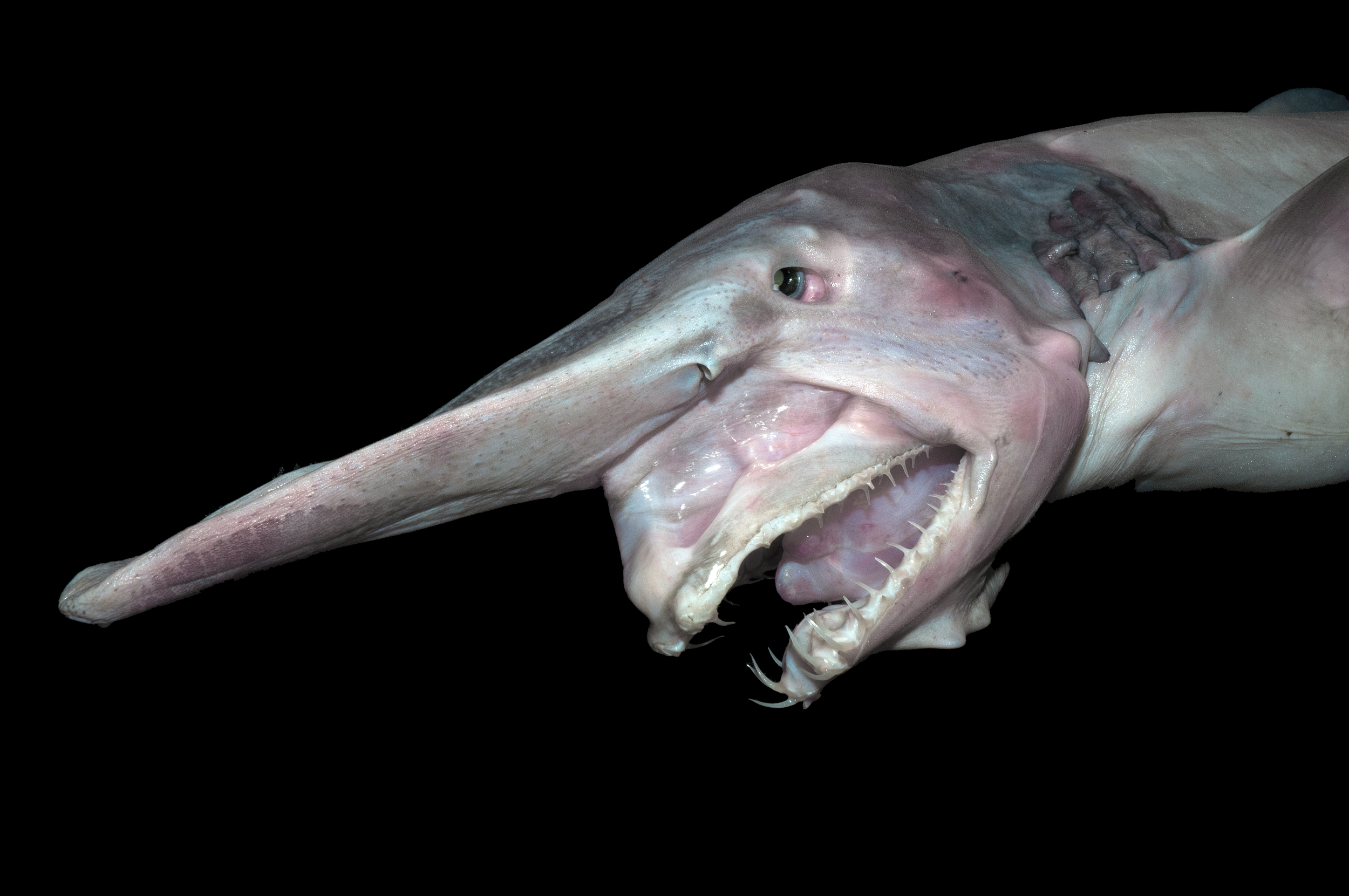
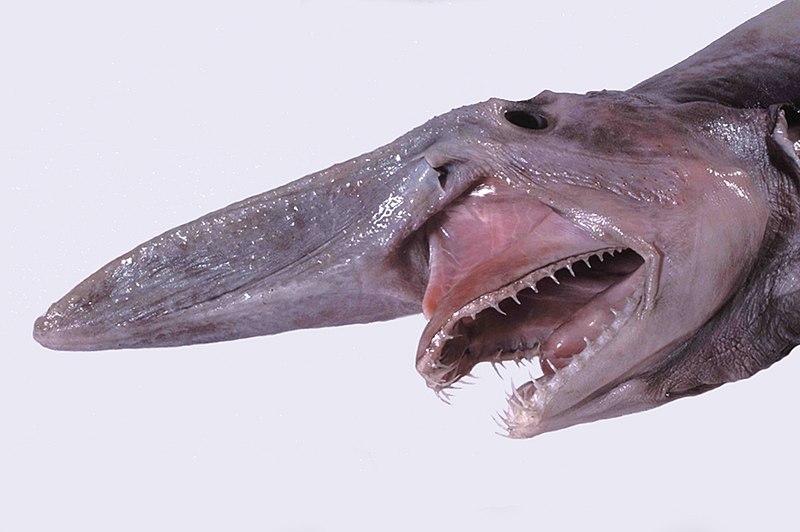
Goblin sharks are highly unusual in appearance due to their long flat noses and prominent jaws which can be catapulted forward to capture prey. Whilst in their usual resting position, the jaws are held taut by two pairs of elastic ligaments. When a Goblin Shark bites, the tension in these ligaments is released and the jaws suddenly protrude forward, almost to the end of the snout. Their noses are covered in electroreceptors called Ampullae of Lorenzini that help detect the electric fields produced by the movement of other sea creatures and potential prey. They feed on bony fishes, crustaceans and cephalopods, like squid. They may be ambush predators.
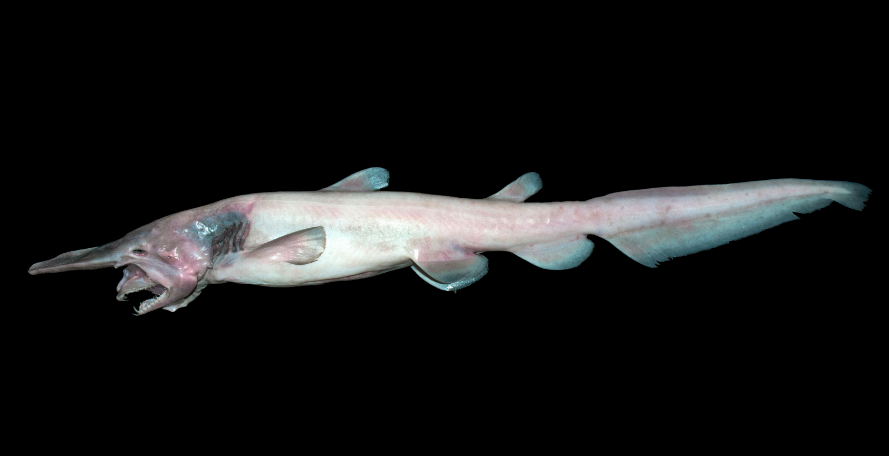
Goblin sharks appear to be pink due to the blood vessels visible through their translucent skin. They are born almost white but darken with age. They are flabby with small fins which suggests they are slow and sluggish. Their flesh and bones are low density and they have large livers rich in oil which all aid buoyancy. This could help Goblin Sharks float towards their prey with minimal movement.
Reproduction
Their reproduction is ovoviviparous, meaning that they lay eggs, but these remain inside the mother until the sharks are fully developed and then there is a live birth. It is not known how long Goblin Sharks live or how fast they grow.
Conservation
They are currently categorized as east concern by the IUCN due to their limited contact with humans and their presence in all three major oceans. The Goblin Shark is rarely caught as bycatch and most reported captures are juveniles, suggesting that most adults live outside the depth range accessible to deepwater fisheries.
Do you have images or videos of Goblin Sharks?
Submit them to [email protected].


Donate Now | Team Sharkwater Newsletter | Group Sales | Shark Database | #SharkFree
Contact Us | Press | Partners | Terms of Use | Privacy Policy
© 2026 Sharkwater Productions - The Truth Will Surface 🦈