


Megamouth sharks are very large, pelagic, migratory sharks, found in tropical and temperate waters worldwide. They are found in the Atlantic, Indian, and Pacific Oceans and live in both shallow and very deep waters, at depths of 5 to 1,500 m (16–4,921 ft).
Biology
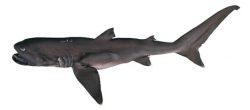
The body of a Megamouth shark is stout and tapers toward the tail, giving it a tadpole-like appearance. It has a large head, an extremely short and broadly rounded snout, and a wide mouth. Its jaw is extendible and can protrude forward while the shark is feeding. This movement helps the megamouth draw water and small prey into its mouth. Its teeth are numerous, very small and hooked, but only a few rows are functional. Megamouth sharks can reach up to 8–9 m (26.2–29.5 ft) and weigh over 700 Kg (1,543 lb) , but adults measure on average around 5–5.5 m (16.4–18.0 ft).
Reproduction
Megamouth sharks are ovoviviparous. This means that embryos develop inside eggs that hatch inside the mother, where they feed on yolk and unfertilized eggs. Little is known about the megamouth’s reproductive cycle.
Behaviour
Megamouth sharks are filter feeders that feed mainly on plankton, especially krill. They are considered slow swimmers and are less active than other plankton-eating sharks. They perform daily vertical migrations to follow the movement of their prey. During the day, they swim at depths of 120 to 160 m (394–525 ft), and ascend to approximately 12 to 25 m (39–82 ft) at night. Despite their size, megamouth sharks are very skittish and are known to flee into deeper waters in response to even minor disturbances.
Conservation
The Megamouth shark is classified as Least Concern by the IUCN. However, the species is rare and its population size and trends remain unknown. The main potential threat is accidental capture as bycatch in longlines, trawls and drift gillnets.
Do you have images or videos of Megamouth Sharks?
Submit them to [email protected].


Donate Now | Team Sharkwater Newsletter | Group Sales | Shark Database | #SharkFree
Contact Us | Press | Partners | Terms of Use | Privacy Policy
© 2026 Sharkwater Productions - The Truth Will Surface 🦈