


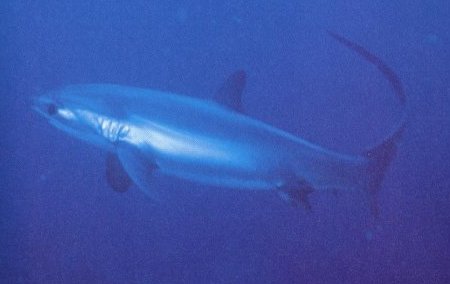
The pelagic thresher, like all the members of its family, is a large pelagic fish known for its extremely long upper tail lobe. Pelagic threshers are found mainly in tropical and subtropical waters of the Pacific and Indian oceans, from the surface to depths of 300 m (984 ft).
Biology and Behaviour
Pelagic threshers are the smallest members of the thresher shark family. The average individual is about 3 m (9.8 ft) long, but some can grow to be over 3.65 m (12.0 ft). Females mature at about 9 to 13 years of age, and both sexes reach lengths of 2.5 m to 3 m (8.2–9.8 ft) at maturity.
Despite their size, pelagic threshers are timid and usually avoid divers and swimmers. When they hunt, they sometimes swim in circles around a school of fish to concentrate the group before striking their prey with their tail. Their diet consists almost exclusively of squid and fish, including herrings and mackerel.
Reproduction and Lifespan
Pelagic threshers are ovoviviparous, embryos hatch inside the uterus and feed on yolk and unfertilized eggs. Their pups are born very large, measuring between 1.58 and 1.90 m (5.2–6.2 ft). Females usually give birth to two pups per litter, but may occasionally have only one young. Their reproductive cycle is thought to be annual.
The exact lifespan of the Pelagic Thresher has not been confirmed, but females may reach 24 to 28 years of age, even though the oldest reported individual was 16 years old.
Conservation
This species is highly valued in commercial fisheries and is used for its meat, liver oil, skin, and fins for soup. It is also often caught as bycatch in fisheries targeting tuna, swordfish or other large pelagic species. They are assessed as Endangered by the IUCN because of their low reproductive rate and their high levels of mortality in target and bycatch fisheries. They are also listed in CITES Appendix II, which means they can’t be exported without a permit, but they can be consumed locally.
Do you have images or videos of Pelagic Thresher Sharks?
Submit them to [email protected].




Donate Now | Team Sharkwater Newsletter | Group Sales | Shark Database | #SharkFree
Contact Us | Press | Partners | Terms of Use | Privacy Policy
© 2026 Sharkwater Productions - The Truth Will Surface 🦈