


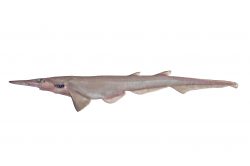
Pinocchio Catsharks are small deepwater sharks that can be found along the Australian continental slope at depths of 485 to 1,035 m (1,591 to 3,396 ft) underwater in open seas near seamounts.
Biology and Behaviour
This catshark is aptly named for its long, flattened prenarial snout. They can vary in colour with a uniform colour of pale brown, light grey and light yellow-brown. Its upper labial furrows are longer than the lower ones.
Reproduction and Lifespan
There is little known about pinocchio cathsarks. They grow to at least 61 cm to 83 cm (24 to 32.7 in) long. Males mature at about 45 to 50 cm (17.7 to 19.7 in) and females 45 to 55 cm.
Conservation and Tourism
The IUCN lists the pinocchio catshark as least concern. In southeast Australia, fishing operations at depths below 700 m is closed to trawling which provides protection for this species. In its Western Australian range, retention of sharks and rays outside of specifically managed shark fisheries has been prohibited in since 2006 (Evans and Molony 2010), and so any incidental catch of this species is released. It would receive refuge in the various marine protected areas in the Australian Commonwealth Marine Park network that overlap with its range, which include includes zoning and gear restrictions (Parks Australia 2024). There are also marine protected areas in the Australian Commonwealth Marine Reserve network.
The Pinocchio Catshark may be caught in the Line Sector of the Australian Commonwealth-managed Coral Sea Fishery and Western Deepwater Trawl Fishery, and the New South Wales Ocean Trawl Fishery, though specific catch information is limited and fisheries effort in the depth range of this species is very low. It is caught and discarded at low levels in deepwater longline and trawl fisheries in the Southern and Eastern Scalefish and Shark Fishery (SESSF), where it is assessed as a low risk species. Reductions in fisheries effort since the 2000s, restrictions on trawl fishing below 700 m in the SESSF from 2007, and closures of fisheries that likely interacted with this species historically (South Tasman Rise Fishery in 2007 and trawling within the Coral Sea Fishery in 2019) limit exposure and provide this species refuge from fisheries at depth across most of its range. There is no evidence of population decline and the species is not suspected to be close to reaching the population reduction threshold. Therefore, the Pinocchio Catshark is assessed as Least Concern. This species is not known to be used or traded.
Do you have images or videos of Pinocchio Catsharks?
Submit them to [email protected].


Donate Now | Team Sharkwater Newsletter | Group Sales | Shark Database | #SharkFree
Contact Us | Press | Partners | Terms of Use | Privacy Policy
© 2026 Sharkwater Productions - The Truth Will Surface 🦈