


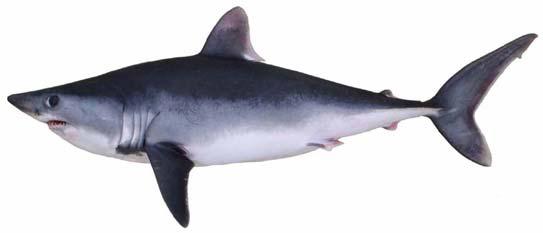
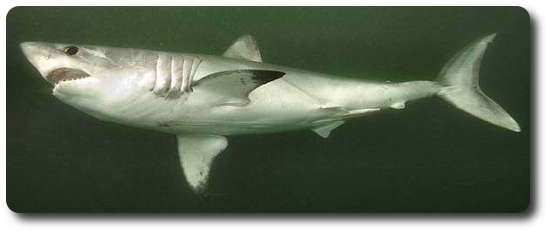
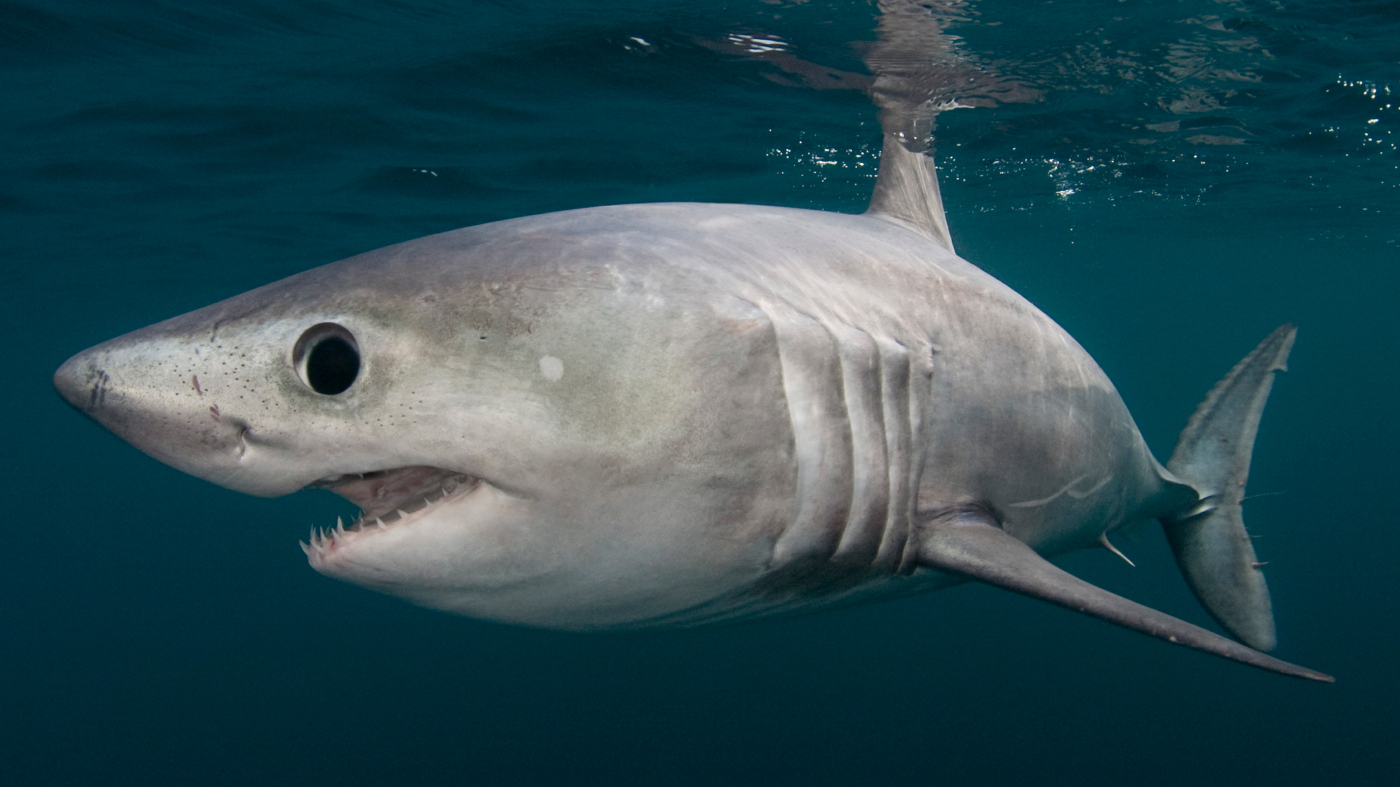
The porbeagle shark, also known as the blue dog, is a medium-sized mackerel shark. It reaches lengths of 2.5m (8.2 ft) and can weigh up to 150Kg (330.7 lbs. Like, it’s cousin, the great white shark, it has a white or light grey underside and its dorsal area is a darker shade of grey. It’s recognizable for its conical snout, large gills, and robust body.
Porbeagle sharks are found in temperate and cold temperate waters of the North Atlantic, South Atlantic, and the Indian Ocean, and they’re highly migratory. Their preferred temperature range is 1-18C. They’re commonly found in waters depths of up to 700m. These sharks have internal adaptations that keep their body temperature higher than the surrounding water.
Porbeagles’ diet consists mostly of smaller fish and cephalopods. Their predators are larger sharks, such as great white sharks, and killer whales.
They are aplacental ovoviviparous fish, where females have their eggs hatch within their body.. Embryos develop inside the mother and eat unfertilized eggs. Their average litter size is four.
Porbeagles were once abundant in the North Atlantic but overfishing decimated their populations. Their meat is highly regarded in several countries and can fetch prices four times higher than blue sharks. In the year 2000, porbeagle populations were just 10% of pre-exploitation levels. This led to to the porbeagle being declared Critically Endangered in the Eastern North Atlantic (Canada and the United States), Endangered in Europe, and Vulnerable worldwide. They’re listed in CITES Appendix II, which means a permit is required to export them. Populations are slowly rebounding, but it’s constrained by slow reproduction rates and bycatch.
Globally, the species is targeted and caught incidentally in coastal and pelagic commercial and small-scale longline, purse seine, and gillnet fisheries, as well as by rod and reel, and is often retained for the high-value meat as well as its fins. Steep declines have occurred in the North Atlantic; with declines also evident, though not as steep, in the Southern Hemisphere. The North Atlantic subpopulation reduction was 50–79% over three generations (58.5 years) and the Southern Hemisphere subpopulation reduction was <20% over three generations (114.9 years). The overall estimated median reduction was 26.5%, with a 41.5% probability of <20% reduction and 45.5% probability of >30% reduction over three generations. Expert judgement elicitation was used to estimate that globally, the reduction is 30–49% over three generations (58.5 and 114.9 years) and therefore, the Porbeagle is assessed globally as Vulnerable A2bd.The Porbeagle is used for its fins, liver oil, and high-quality meat (Francis et al. 2008, Hernandez et al. 2008). Together with the Salmon Shark, the two species accounted for 0.2% of the fin imported in Hong Kong in 2014 (Fields et al. 2018). In some counties, such as Spain, Porbeagle meat accounts for a significant proportion, at 15%, of all shark meat imported annually (Dent and Clarke 2015).
The success of actions agreed through international wildlife and fisheries treaties depends on implementation at the domestic level; for sharks, such follow up actions have to date been seriously lacking.
In 2008, the Porbeagle was listed on Appendix II of the Convention on Migratory Species (CMS), which reflects Parties’ commitments to work regionally toward conservation. The species is also covered by the CMS Memorandum of Understanding for Migratory Sharks, which is aimed at facilitating conservation. In 2013, the Porbeagle was added to Appendix II of the Convention on International Trade in Endangered Species (CITES), which requires CITES Parties to ensure that exports be accompanied by permits based on findings that parts are sourced from legal and sustainable fisheries.
In 2010, the North-East Atlantic Fisheries Commission (NEAFC) adopted a ban on directed fishing for Porbeagle that has since been renewed several times. The current (2016) measure runs through 2019 and applies to the NEAFC Regulatory Area (high seas). The Western and Central Pacific Fisheries Commission (WCPFC) designated the Porbeagle as a “Key Shark Species” in 2010, but has yet to set Porbeagle fishing limits. In 2012, the General Fisheries Commission for the Mediterranean (GFCM) banned retention and mandated careful release for the Porbeagle and 23 other elasmobranch species listed on the Barcelona Convention Annex II. Implementation by GFCM Parties, however, has been very slow. In 2015, to address depletion in the North Atlantic, the International Commission for the Conservation of Atlantic Tunas (ICCAT) adopted a requirement for prompt, careful release of Porbeagles retrieved alive in ICCAT-managed fisheries. ICCAT also pledged to consider additional measures if future Porbeagle catches exceed 2014 levels.
To prevent overfishing and allow recovery, it is recommended that Porbeagles be subject to regional and national catch limits based on scientific advice and/or the precautionary approach, as well as improved reporting of catch data (including discards), efforts to minimize bycatch mortality, and full implementation of all commitments agreed through international treaties.
Porbeagle shark photo upper and below right: © Doug Perrine
Do you have images or videos of Porbeagle Sharks?
Submit them to [email protected].




Donate Now | Team Sharkwater Newsletter | Group Sales | Shark Database | #SharkFree
Contact Us | Press | Partners | Terms of Use | Privacy Policy
© 2026 Sharkwater Productions - The Truth Will Surface 🦈