


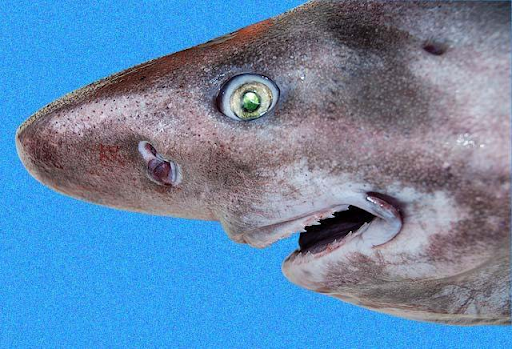
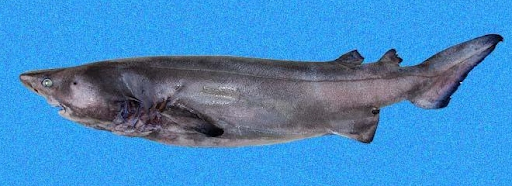
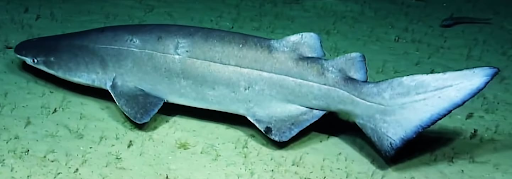
The Echinorhinus cookei, or Prickly Shark, is identified by its large, thorn-like denticles on the body. This rare, deepwater shark is found from 11 to 1100 metres (36 to 3,609 ft) deep in the Western Pacific Ocean off Japan, Taiwan, Palau, Australia and New Zealand, and in the Eastern Pacific off Hawaii, USA, Gulf of California, and from Costa Rica to Peru and Chile. They are also reported to be found in Nicaragua.
The Prickly Shark is a large, sluggish shark that could reach up to 400 cm (157.5 in) long. Females mature between 250 and 300 cm(98.4 and 118.1 in) while some males mature by 198 cm (78 in). Mating occurs by distinct pairing with embrace and females are ovoviviparous, meaning it produces young by means of eggs that hatch inside the mother’s body, with up to 114 pups in a litter. Each pup is born at 40-45 cm (15.7–17.7 in) long.
They appear to be quite vulnerable to deepwater trawling and line fishing and, as these fishing activities increase, there is potential for ongoing reduction of these species. There is also no conservation methods currently in place.
The Prickly Shark is very rarely recorded as incidental catch from commercial and artisanal fisheries across its range, however, it may be misidentified as its cogener, the Bramble Shark (Echinorhinus brucus). The deep depth range and diel migrations of the Prickly Shark may offer it refuge from fishing effort, although high site fidelity may increase its susceptibility to localised depletion. Beyond some information provided from around the Monterey Canyon, there is virtually no information on the ecology, and population size and trends of Prickly Shark, despite its widespread distribution. Interactions with fisheries are limited to a handful of records. Due to the absence of information on the impacts of fisheries and the issue of misidentification, this species is assessed as Data Deficient. This species is not known to be utilized. The largest known aggregation of this species (>30 individuals) was recorded from the Monterey Canyon (Crane and Heine 1992, Dawson and Starr 2009). The Prickly Shark has not been identified as a species that is likely to benefit from Marine Protected Areas (MPAs) within the state of California (CDFW 2007), however, the Soquel Canyon State Marine Conservation Area protects part of the Monterey Submarine Canyon from most fishing effort (CDFW 2016), and may provide some refuge for the Prickly Shark in this region. Tagged sharks have been shown to remain sedentary during the day (Dawson and Starr 2009), and the deep depth distribution of Prickly Sharks may offer some refuge from fishing across its range.
Do you have images or videos of Prickly Sharks?
Submit them to [email protected].


Donate Now | Team Sharkwater Newsletter | Group Sales | Shark Database | #SharkFree
Contact Us | Press | Partners | Terms of Use | Privacy Policy
© 2026 Sharkwater Productions - The Truth Will Surface 🦈