


Redspotted Catsharks, also known as Chilean Catshark, can be found in the Southeast Pacific Ocean near Chile and Peru down to 100m/328 ft deep.
Biology and Behaviour
Redspotted catsharks can grow up to 60 cm(23.6 in) long. In the spring and summer, they swim inshore at depths of 8 to 15 m(26 to 49 ft) deep close to rocky areas. During the winter, they migrate towards the bottom and can be found between 15 to 100 m (49 to 328 ft) deep offshore.
Redspotted catsharks are nocturnal and solitary sharks. They stay in caves and crevices during the day and come out at night to hunt for food. They feed on small crustaceans and invertebrates that live near rocky bottoms as well.
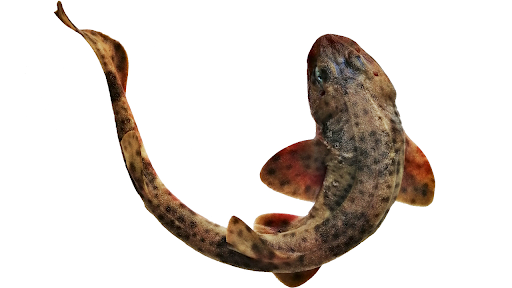
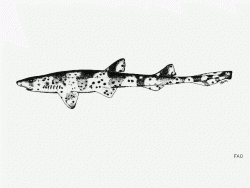
Their bodies are elongated and sleek. Their dorsal side is a dark red-brown with dark saddle patterns on their side. Their ventral sides are an off-white with reddish spots.
Reproduction and Lifespan
Redspotted catsharks are oviparous, meaning it lays eggs.. The size of birth of pups is 14 cm (5.5 in) long. Females mature between 52 to 54 cm (20.5 to 21.3 in) while males mature between 42 to 46 cm (16.5 to 18.1 in) long. Males have longer teeth which is believed to help them when mating.
Conservation and Tourism
There are no conservation measures currently in place. This catshark may be occasionally caught in inshore coastal gillnet and line fisheries in Chile and Peru and is usually discarded dead, but is occasionally used for fishmeal. It lays eggs in association with kelp (Lessonia spp.) and hence may be affected by ecosystem modification due to kelp exploitation for agar production. The low level of catch combined with small body size indicates that it may be productive enough to withstand some fishing pressure. Therefore, there is nothing to infer or suspect population reduction at this time and the Chilean Catshark is assessed as Least Concern.This species is usually discarded dead, but is used for fishmeal or ‘harina de pescado’ (Lorenzen et al. 1979, Leible and Alveal 1982). Further research is needed on life history, population size, trend in abundance, and threats.
Do you have images or videos of Redspotted Catsharks?
Submit them to [email protected].


Donate Now | Team Sharkwater Newsletter | Group Sales | Shark Database | #SharkFree
Contact Us | Press | Partners | Terms of Use | Privacy Policy
© 2026 Sharkwater Productions - The Truth Will Surface 🦈