


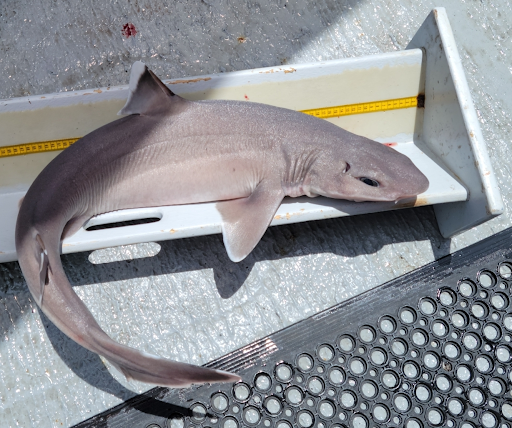
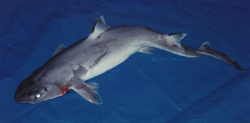
The roughskin spurdog is a widespread species of dogfish found in warm and temperate waters of the Atlantic, Pacific, and Indian Oceans, at depths of 200 to 650 m (656 to 2,133 ft). It is most common along the Atlantic coast of the United States.
These sharks are ovoviviparous, meaning it produces young by means of eggs that hatch inside the mother’s body, and have large litters of sometimes over 20 pups. They grow to a maximum length of 1.2 m (3.9 ft). Adults feed on bony fishes and squid.
The species is not known to be targeted, however, extensive fishing has occurred across much of its spatial and depth range and it may be incidentally caught in demersal trawl or longline fisheries. Further information is required on the taxonomy, distribution, life history, and in particular, bycatch levels of the Roughskin Spurdog. Since it is unknown if fishing is causing a population reduction, there is currently inadequate information available to assess the species beyond Data Deficient. This species is not known to be utilized.
The species is reported from some regions with limited fishing effort. For example, in the United States Gulf of Mexico, Royal Red Shrimp (Pleoticus robustus) trawl fisheries operate on relatively restricted fishing grounds adjacent to home ports at depths of 250–550 m (Stiles et al. 2007, Reed and Farrington 2010). The bottom fish fishery operating in the Hawaiian Archipelago targets deep-water snappers and groupers (Etelis and Pristipomoides spp) at depths <400 m depth (DLNR 2019). Off southern Africa, the Roughskin Spurdog has been reported in very low numbers (annual average catch < 1 t) from prawn trawl fisheries between 2010–2012 (da Silva et al. 2015).
The species has also been reported from parts of Central and South America that have undergone intensive fishing activity. Industrial trawling for shrimp and demersal species was introduced in the 1940s and increased rapidly from the 1960s until the 1980s when there were 450 registered vessels (Mendoza 2015). Artisanal fisheries dominate the catch in Venezuela, employing a number of gear types. Deep-water fisheries began in 2000 and have expanded geographically, and some stocks have collapsed (O. Lasso pers. comm. 30/05/2018). Off Brazil, deep-water fisheries along the southeast and southern coasts developed in the late 1990s to remove some pressure from depleted coastal resources (Dallagnolo et al. 2009). Four main fisheries (hook and line, demersal gillnet, pots, and demersal trawls) targeted a variety of species including monkfish (Lophyus gastrophysus), the Argentine Hake (Merluccius hubbsi), and deep-water shrimps (family Aristeidae) at depths of 200–1,000 m+. The species has been landed as frequent catch from bottom longline fisheries, and occasional catch from demersal gillnet and trap fisheries from southern Brazil (Mazzoleni and Schwingel 1999). Fishing activities mostly ceased in 2006, but may return at any point in the future due to the dynamic nature of Brazilian fisheries.
There are no species-specific measures in place for the Roughskin Spurdog. Throughout the main Hawaiian Islands, there are a series of Marine Protected Areas (MPAs) referred to as Bottomfish Restricted Fishing Areas (BRFAs) (DLNR 2019). These are generally closed to industrial and recreational bottom fishing and may offer the species refuge. Further information is required on its distribution, taxonomy, life history, and most importantly, interactions with fishing activities.
Do you have images or videos of Roughskin Spurdogs?
Submit them to [email protected].


Donate Now | Team Sharkwater Newsletter | Group Sales | Shark Database | #SharkFree
Contact Us | Press | Partners | Terms of Use | Privacy Policy
© 2026 Sharkwater Productions - The Truth Will Surface 🦈