


Roughtail Catshark, also known as the marbled catshark, can be found in the western central Atlantic Ocean at depths between 250 to 750 m (820 to 2,461 ft).
Biology and Behaviour
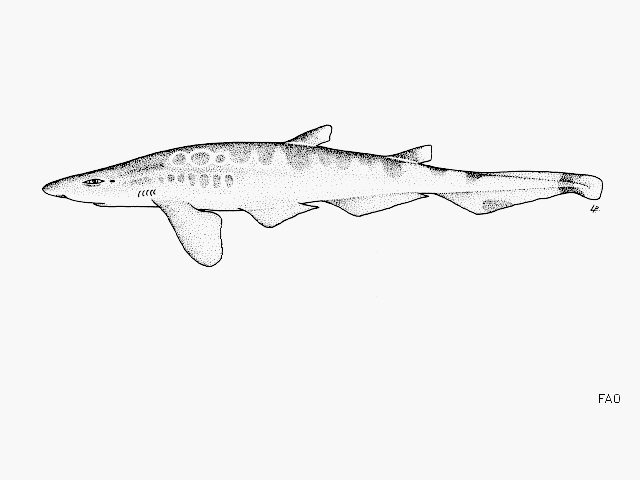
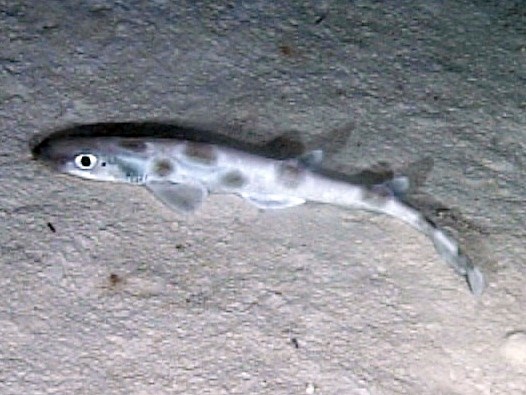
Roughtail catsharks are a small, slender species that grow up to 33 cm (13 in) long. They have a marbled coloured pattern of dark saddles and spots along their back.Their snout is long and pointed and their horizontal oval eyes have nictitating membranes to protect their eyes. They also have a prominent crest of enlarged dermal denticles along the dorsal edge of their caudal fin, hence their name, roughtail catshark.
Roughtail catsharks mainly feed on shrimp.
Reproduction and Lifespan
Roughtail catsharks are ovoviviparous, meaning it produces young by means of eggs that hatch inside the mother’s body, and females lay eggs in pairs. Females and males mature between 27 to 33 cm long.
Conservation and Tourism
There are currently no conservation measures in place for this species.
No information is available on interactions with fisheries and while it is a potential bycatch of deeper water demersal trawl and longline fisheries in the United States, its wide depth range provides it with refuge outside of fishing activities. There is also a general lack of deepwater fisheries in the southern part of its range in the Central American Caribbean. Population trend is unknown, although it is suspected to be stable based on the absence of fishing effort within its range. Therefore, there is nothing to infer or suspect population reduction at this time and the species is assessed as Least Concern.This species is not likely to be utilized due to its small size and a lack of deepwater fisheries in the Caribbean.Further surveys are required to better define the species’ distribution, depth range, and biology. Careful monitoring should also be undertaken should fisheries expand to greater depths in the region.
Do you have images or videos of Rough-tail Catsharks?
Submit them to [email protected].


Donate Now | Team Sharkwater Newsletter | Group Sales | Shark Database | #SharkFree
Contact Us | Press | Partners | Terms of Use | Privacy Policy
© 2026 Sharkwater Productions - The Truth Will Surface 🦈