


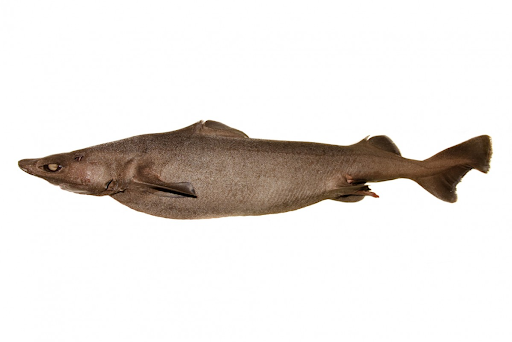
Also known as the Roughskin Dogfish Shark or Owston’s Dogfish, is a sleeper shark of the Somniosidae family, found around the world on continental shelves in tropicals, subtropical and temperate seas.
Biology:
This species is of dark brown or black colour, it has dorsal fins with extreme tips of fin spines protruding from the fins, moderately long snout, lanceolate upper teeth and bladelike lower teeth with short, oblique cusps, with a fairly stocky body that does not taper abruptly from the pectoral region. Males mature are about 70 to 79 cm (27.6 to 31.1 in) Tl, and females mature at about 82 to 105 cm (32.3 to 41.3 in) TL. The maximum size recorded is of 120 cm (47.2 in). Size at birth ranges from 25 to 30 cm (9.8 to 11.8 in) TL.
This species is ovoviviparous, meaning it produces young by means of eggs that hatch inside the mother’s body, with 16 to 28 pups per litter. Information on gestation period and reproductive cycle are not well known.
Habitat:
A moderately common deepwater shark within its known geographic range, and which may extend deeper than is currently recognized. Found mainly in the Atlantic, Pacific, and Indian Oceans. Marine, demersal, this shark occurs on the upper and middle continental slope between 250 to 1,500 m (820 to 4,921 ft), usually 500 to 1,500 m (1,640 to 4,921 ft).
Behaviour:
The Roughskin Dogfish feeds on fishes and squids. This shark sometimes occurs in schools segregated by size and sex.
Conservation and threats:
The Roughskin Dogfish is taken incidentally in benthic trawl and longline (surface and benthic) fisheries across its range. The species has been reported under a generic code in many regions, or misidentified with other Centroscymnus species, including the Portuguese Dogfish (C. coelolepis). At this time, there are some species-specific management actions in place for the Roughskin Dogfish in part of its range. Fisheries closures and restrictions in the Tasman Sea may indirectly offer this species some refuge, but mitigation for deepwater dogfish in the Northeast Atlantic, where fishing effort is high, do not cease the capture of this species as bycatch.
This is a low productivity species, and based on current levels of exploitation, it is inferred that the global population has declined by at least 30% over the past three generations (90 years) given actual levels of exploitation in core areas of its range, particularly the Northeast Atlantic, New Zealand and Australia. This species is therefore assessed as Vulnerable A2d.
The Roughskin Dogfish is utilized for its flesh and squalene oil, and is also used for fishmeal (Roberts et al. 2015, Compagno 2016). In Australia and New Zealand, >90% of catches have historically been retained (Walker and Gason 2007, Ministry of Fisheries 2008).
Further information is required on population size and trends of the Roughskin Dogfish, as well as interactions with fisheries across its range. Some management arrangements in New Zealand, Australia, and the Northeast Atlantic are relevant to this species.
Southwest Pacific
New Zealand has had a Quota Management System (QMS) in place since 1986 to provide for the sustainable management of its fisheries. The Roughskin Dogfish is a non-QMS species, meaning that there is no species-specific management in place for the species (MPI 2013). New Zealand has a system of Benthic Protected Areas (BPAs), however they are unlikely to provide any major refuge for this species given the spatial occurrence of the BPAs (see Black and Tilney 2015). In Australia, catches of Roughskin Dogfish are controlled by basket trip limits to prevent targeted fishing (Walker and Gason 2007). A combination of trawling closures in most of the Southern and Eastern Scalefish and Shark Fishery (SESSF) waters deeper than 700 m since 2005, as well as the closure of the South Tasman Rise Fishery in 2007 (Patterson et al. 2016), may indirectly offer this species some refuge in this region.
Northeast Atlantic
Since 2010, the European Union Fisheries Council prohibited direct fishing for deepwater sharks in European Community and international waters, and in 2012, no allowances for bycatch were implemented (ICES 2016). Additional management actions for this region include banned use of trawls and gillnets in waters >200 m in Azores, Madeira and Canary Islands and international waters regulated by ICES (NEAFC regulatory Area); banned use of gillnets by EU vessels at depths >600 m; maximum bycatch limits of deepwater shark in Hake (Merluccius merluccius) and Monkfish (Lophius spp.) gillnet catches; area restrictions by vessel size and gear, gear restrictions (hook size, maximum number of hooks on longline gear), and a network of closed areas in Azorean waters; closure of the Condor seamount to deepwater fishing in 2010 (ICES 2016).
Do you have images or videos of Roughskin Dogfishs?
Submit them to [email protected].


Donate Now | Team Sharkwater Newsletter | Group Sales | Shark Database | #SharkFree
Contact Us | Press | Partners | Terms of Use | Privacy Policy
© 2026 Sharkwater Productions - The Truth Will Surface 🦈