


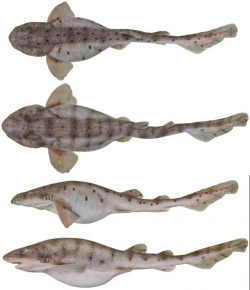
The saddled swellshark is a species of catshark endemic to eastern Australia. Like all catsharks, they’re bottom feeders, have elongated cat-like eyes, and two small dorsal fins set far back. They’re mostly nocturnal and often sleep in groups during the day. Their diet consists of bony fishes and bottom-dwelling crustacean and cephalopods. They’re found at depths of 110 – 600 m (361 – 1,969 ft).
They’re oviparous, meaning it lays eggs. Their eggs are about 8 cm (3 in) long. Young become mature at 58 cm (22.8 in), and grow to a maximum length of 72 cm (28.3 in).
Their name comes from the saddles on their dorsal side and their ability to inflate their bodies with air or water to appear larger to predators.
They’re sometimes caught by prawn and fish trawl fisheries. Given their rarity, small range, and by-catch rates, they’re close to being vulnerable. The IUCN considers them Near Threatened.
Parts of the southern portion of this species’ range (southern Queensland and central-southern New South Wales) receive high trawling effort from prawn and fish trawl fisheries. Fishing effort on the New South Wales upper slope remains high (Patterson et al. 2018). Off southern Queensland, the East Coast Trawl Fishery targets prawns including to depths of ~300 m and a developmental deepwater trawl fishery at 250–800 m may take the Saddled Swellshark as bycatch (Department of Environment 2016). Current demersal fishing effort, however, in the northern portion of its range (central and northern Queensland) is very low (the Coral Sea Fishery has a limited number of fishing permits and there has been no trawling since the 2006–07 fishing season; Patterson et al. 2018). There is no utilization or trade of this species. There are no species-specific conservation actions in place. Catches should be monitored in commercial fisheries.
Do you have images or videos of Saddled Swellsharks?
Submit them to [email protected].


Donate Now | Team Sharkwater Newsletter | Group Sales | Shark Database | #SharkFree
Contact Us | Press | Partners | Terms of Use | Privacy Policy
© 2026 Sharkwater Productions - The Truth Will Surface 🦈