


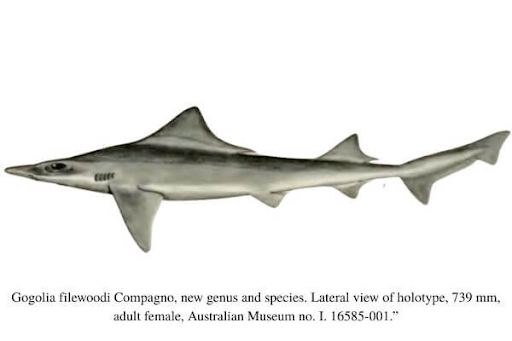
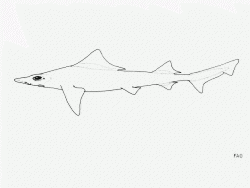
The Sail-back Houndshark is known from only one specimen, a pregnant female of 74 cm (29 in) long was carrying two pups, that was caught from a river mouth at a depth of 73 m (240 ft).
Biology and Behaviour
Sail-back houndsharks are presumably endemic to Papua New Guinea.
There is very little known about the biology of this species.
Reproduction and Lifespan
This species is ovoviviparous, meaning it produces young by means of eggs that hatch inside the mother’s body, with a little size of two which indicates sail-back houndsharks have a low intrinsic rate of population increase.
Conservation and Tourism
There is currently no conservation measures in place.
Further information is required on the distribution, ecology, and life history of the Sailback Houndshark, as well as any potential fisheries interactions. Since it is unknown if fishing is causing a population reduction, there is currently inadequate information available to assess the species beyond Data Deficient.
There are no fisheries currently operating in the region, although current fishing practices are not well documented (L. Baje pers. comm. 21/11/2019). In 1983, a deep-water dropline fishery operating to depths of 400 m was developed to target demersal snappers in the East Sepik Province (Chapau 1986). Additional deep-water surveys across Papua New Guinea using a number of gear types took place between 1979–1986 but fisheries did not develop further (Chapau 1988, Chapman 1998). The Sailback Houndshark was not reported from these surveys. The species is not known to be utilized.
Do you have images or videos of Sail-back Houndsharks?
Submit them to [email protected].


Donate Now | Team Sharkwater Newsletter | Group Sales | Shark Database | #SharkFree
Contact Us | Press | Partners | Terms of Use | Privacy Policy
© 2026 Sharkwater Productions - The Truth Will Surface 🦈