


The Oxynotus Paradoxus, also known as the Sailfin Roughshark, is a species of dogfish shark in the Oxynotidae family, found in the eastern North Atlantic from Scotland to Senegal.
Biology:
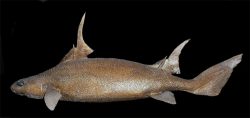
The Sailfin Roughshark is a rare shark. At birth, this species is about 25 cm (9.8 in) in length and can grow up to 118 cm (46.5 in) in length. It has a compressed body form with a blunt snout and wide, flattened head. It has two tall, narrow and pointed dorsal fins that contain concave trailing edges, but no anal fin. The first dorsal spine trails back, a unique feature of this species of Oxynotus. This is the only species to have an incline first dorsal fin spine. The color of the shark when living is uniformly dark brown, however, it turns black in a preserved specimen.
This shark is an ovoviviparous species, meaning it produces young by means of eggs that hatch inside the mother’s body. These sharks feast on small benthic fish and invertebrates.
Habitat:
The Sailfin Roughshark is an uncommon deepwater bottom shark found at depths from 265-720 m (869–2,362 ft). The species’ known depth range is entirely within the range of deepwater fisheries operating in the Northeast Atlantic, although the Mid-Atlantic ridge and southern part of its range probably offer some refuge from fishing pressures. Based on the distribution of the Oxynotus Paradoxus, occupying a bathybenthic habitat, the species can be classified as benthos organism with reproductive migrations to the continental shelf in spring.
Threats and conservation:
The Sailfin Roughshark is very infrequently reported as bycatch in demersal trawl fisheries across its range and may inhabit depths beyond the reach of some regional fishing activities. Off West Africa, there are a number of European distant-water vessels using demersal trawl and longline to target demersal fish and shrimp species that reach the depth limit of the species. The Sailfin Roughshark is listed as a deep-water shark species in European Union regulations, and various management actions apply to such listed deep-water sharks, including a prohibited on targeted fisheries, a Total Allowable Catch (TAC) for shark bycatch in longline fisheries targeting Black Scabbardfish (Aphanopus spp), and depth limits beyond which gillnets and demersal trawl fisheries are prohibited in some areas. Oxynotus species are highly susceptible to population decline from fishing with estimated population reductions of 80% over three generation lengths (60 years) in areas with high fishing effort. There is high distribution overlap with intensive fishing pressure, reported declines of deep-water sharks in part of its range, some relevant management across part of its range, and possible refuge at depth. The Sailfin Roughshark is suspected to have undergone a population reduction of 30–49% over the past three generation lengths (60 years) based on actual levels of exploitation, and it is assessed as Vulnerable A2d. The species may be used for fishmeal.
Further information is required on population size and trends of the Sailfin Roughshark, as well as interactions with fisheries across its range, particularly around Africa. There are some general management arrangements of relevance in place in the Northeast Atlantic. In 2010, the European Union Fisheries Council prohibited direct fishing for deep-water sharks, including the Sailfin Roughshark, in European Community and international waters, and in 2012, no allowances for bycatch were implemented (ICES-WGEF 2019). Since 2017, a restrictive bycatch allowance (10 t) was trialled, permitting limited landings of unavoidable catches of deep-water sharks in directed artisanal demersal longline fisheries for Black Scabbardfish (Aphanopus spp). Additional management actions for this region include banned use of trawls and gillnets in waters >200 m depth in Azores, Madeira and Canary Islands and international waters regulated by ICES (NEAFC regulatory Area); banned use of gillnets by European Union vessels at depths >600 m; maximum bycatch limits of deep-water shark in Hake (Merluccius merluccius) and monkfish (Lophius spp) gillnet catches; area restrictions by vessel size and gear, gear restrictions (hook size, maximum number of hooks on longline gear), and a network of closed areas in Azorean waters; closure of the Condor seamount to deep-water fishing in 2010 (ICES-WGEF 2019).
Do you have images or videos of Sail-fin Roughsharks?
Submit them to [email protected].


Donate Now | Team Sharkwater Newsletter | Group Sales | Shark Database | #SharkFree
Contact Us | Press | Partners | Terms of Use | Privacy Policy
© 2026 Sharkwater Productions - The Truth Will Surface 🦈