


Sarawak pygmy swellshark can be found off the coast of China and Malaysia in the Northwest Pacific Ocean and the Western Central Pacific Ocean at depths between 118 to 165 m (387 to 541 ft).
Biology and Behaviour
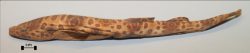
Adult Sarawak pygmy swellsharks have two wide brown saddle blotches before its first dorsal fin, while young swellsharks have three and spots along its body and fins.
They are rarely taken as bycatch, and are only known from a few caught specimens. The maximum length this species can reach is 40.8 cm (16 in) long. Males mature between 32.5 to 37.2 cm (12.8 to 14.6 in) long, while females mature at 35.4 to 40.8 cm (13.9 to 16.1 in) long.
Like other swellsharks, balloon sharks can inflate its stomach with water or air as a defence mechanism against predators.
Reproduction and Lifespan
The biology of the sarawak pygmy swellshark is almost unknown. They are oviparous, meaning it lays eggs, and young sarawak pygmy swellsharks are about 10 cm (3.9 in) long at birth.
Conservation and Tourism
The species is a bycatch of industrial and artisanal fisheries with multiple gears, including demersal trawl, longline, and gillnet, and is retained, mostly for fish meal. Landings data of all sharks combined from the Taiwan Exclusive Economic Zone (EEZ) and reconstructed catches of all sharks, skates and rays from the China, Viet Nam, Cambodia, Peninsular Malaysia, Sabah, and Sarawak EEZs indicate declines of 54–98% over the past three generation lengths (45 years). These levels of declines are not species-specific but are informative for understanding the broader levels of decline in sharks in the region. The species has no refuge from fishing pressure and swellsharks are very sensitive to fishing pressure; even when fisheries management is implemented, intensive fishing can lead to significant declines of >80% over three generation lengths. It is suspected that the Sarawak Pygmy Swell Shark has undergone a population reduction of >80% over the last three generation lengths (45 years) due to levels of exploitation, and it is assessed as Critically Endangered A2d. The Sarawak Pygmy Swell Shark is of limited value for food and is considered a trash fish and used for fish meal.
No specific measures are in place. In Taiwan, since the mid–2000s, gillnets have been banned within 3 nautical miles (nm) in parts of five counties with a policy of gradual removal of gillnets from within 3 nm of the entire coast and government assistance to transition to line and troll fishing (Fisheries Agency 2019, Liao et al. 2019). In China, since the late 1990s, regulations have specified varying annual seasonal fishing closures on commercial demersal trawling in the South China Sea to 12⁰N (Yu and Yu 2008). In 2018, this seasonal closure was widened to also include all other commercial fishing gears (e.g. gillnet and longline) with the only exception being for rod and reel to allow small-scale artisanal fisheries and recreational fisheries (J. Zhang pers. comm. 27 August 2019). In Viet Nam, there is a prohibition on destructive fishing practices, and some fisheries regulations, however, enforcement and compliance is limited (Teh et al. 2014b). In Thailand, all commercial fishing vessels greater than 10 Gross Tonnage are prohibited to fish within three nautical miles from the shore (DoF 2015). Most marine protected areas (MPAs) in the region are found in inshore, shallow waters and thus, are unlikely to provide any refuge for this species.
To conserve the population and to permit recovery, a suite of measures will be required which may include species protection, spatial management, bycatch mitigation, and harvest and trade management measures (including international trade measures). Effective enforcement of measures will require ongoing training and capacity-building (including in the area of species identification). Catch monitoring is needed to help understand population trends and inform management.
Do you have images or videos of Sarawak Pygmy Swellsharks?
Submit them to [email protected].


Donate Now | Team Sharkwater Newsletter | Group Sales | Shark Database | #SharkFree
Contact Us | Press | Partners | Terms of Use | Privacy Policy
© 2026 Sharkwater Productions - The Truth Will Surface 🦈