


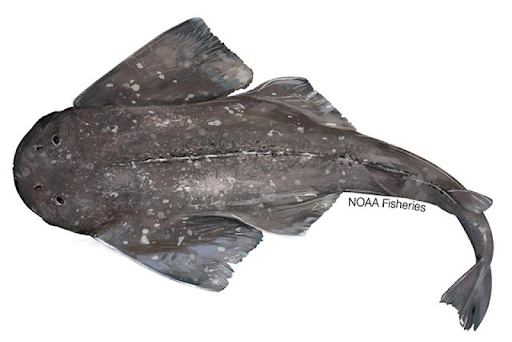
The Sawback Angelshark sometimes referred to as monkfish, is a critically endangered shark which is native to the Mediterranean and the eastern Atlantic. Their habitat is an intensely fished area and they are easily caught by trawlers, as they like to lie on the bottom of the ocean in the sand. They were commonly caught in the Balearic Islands in the 1970s and 1980s but now the Mediterranean population has almost completely disappeared.
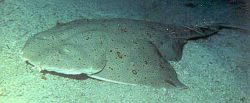
These Angelsharks are cunning predators who can lie still, camouflaged, on the ocean floor for weeks at a time. They wait until their prey is in range before they suddenly strike. They subsist on smaller sharks, bony fish and cuttlefish, as well as crustaceans like shrimps and crabs. They enjoy subtropical waters and are usually found on the muddy bottom of the ocean between 30 and 500m (98 and 1,640 ft) down.
Like other angel sharks, they are wide and flat, almost like a ray. They get their name from their wide, wing-like pectoral fins. When fully grown, the Sawback Angelshark can reach up to 188cm (6 ft 2 in) in length. Oviparous, meaning it lays eggs.
Most of this region is now subject to intense demersal fisheries, and the species is highly susceptible at all life stages to bycatch in demersal trawls, set nets, dredges, and bottom longlines operating through most of its range and habitat. Industrial and artisanal fishing pressure is intense and often unregulated in this region and it is suspected that this will continue at the current level or increase in the future. As a result of its limiting life history characteristics and bycatch in fisheries with steadily increasing effort and capacity, its abundance has declined dramatically during the past 50 years. It is now extremely uncommon throughout most of its range, and many records of angel sharks are only reported to genus level. Along the West African coast this species is taken as occasional bycatch of industrial trawl and artisanal gillnet fisheries and was reported as common in Russian-led surveys during the 1970s and 1980s. Portuguese landings data from the fleet operating off Morocco and Mauritania, aggregated for the three native angel shark species combined indicates a 95% decline in catch-per-unit-effort (CPUE) from 1990 to 1998. The available data from this region indicate that there are very few recent records. It is suspected that the species has undergone overall declines of at least 80% across its range over the past three generation lengths (~45 years), and bycatch is likely to continue. Therefore, this species is assessed as Critically Endangered A2bcd+3cd.This species is caught and retained as bycatch. It is likely utilized for meat in West Africa and possibly elsewhere.
The General Fisheries Commission for the Mediterranean has adopted a measure (GFCM/36/2012/3) to prohibit retention, transshipment, landings, storage, display, and sale of 24 species, including the three native Mediterranean angel shark species listed on the Barcelona Convention’s Annex II of the Protocol concerning Specially Protected Areas and Biological Diversity in the Mediterranean. Regulation ((EU) 2015/2102) Article 16j further reinforces the GFCM measure for EU vessels prohibiting retention, landings and sale, and requiring live release where possible. Greater implementation would improve the effectiveness of all measures previously listed.
Within eight Balearic Island marine reserves, fishing for these species is forbidden and accidental captures must be released. All three native angel sharks have been protected within Spanish Mediterranean waters since 2012 through the Spanish List of Species Under Special Protection (LESPRE) Orden AAA/75/2012. In Maltese waters angel sharks have been protected since 2013. Furthermore, Israel listed all shark species under domestic regulations (Ariel and Barash 2015), although enforcement is low. In April 2018 through Communique 2018/19, the Turkish Government announced updates to Article 5 of the Turkish Prohibited Species lists (Communique 2016/35), with the addition of 14 elasmobranch species, which includes the three species of angel shark found in the Mediterranean. This species is included in the attached Supplementary Information: ‘Eastern Atlantic and Mediterranean Angel Shark Conservation Strategy’ (Gordon et al. 2017). The goals of the strategy are to: i) minimize fishery mortality; ii) identify and protect areas critical to angel shark survival, reproduction, and recovery; and, iii) identify human interactions and minimize the negative impacts. Policy priorities from the strategy include (but are not limited to) listing the species on Spanish domestic fishery regulations (in process), implementing GFCM measures, including listing of the species in EU Common Fisheries Policy (CFP), and possibly listing on the Convention of Migratory Species pending data confirming migratory behavior (Gordon et al. 2017).
The Angel Shark Conservation Network was created with the aim to facilitate collaborations and collect information about angel sharks throughout their range (www.angelsharknetwork.com). For this purpose, an interactive map (www.angelsharknetwork.com/#map) was created to register sightings of all of the native angel sharks.
Do you have images or videos of Sawback Angelsharks?
Submit them to [email protected].


Donate Now | Team Sharkwater Newsletter | Group Sales | Shark Database | #SharkFree
Contact Us | Press | Partners | Terms of Use | Privacy Policy
© 2026 Sharkwater Productions - The Truth Will Surface 🦈