


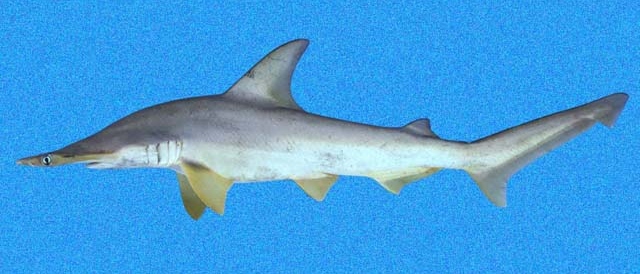
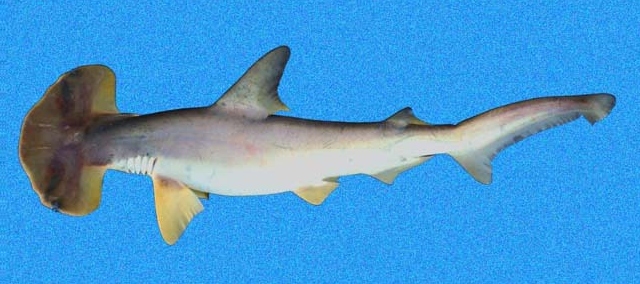
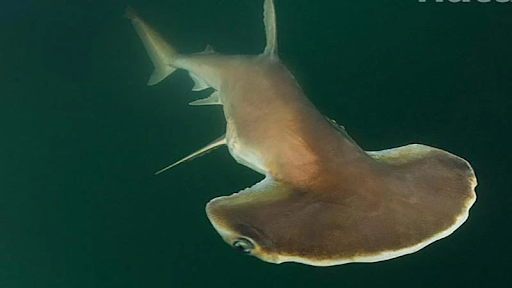
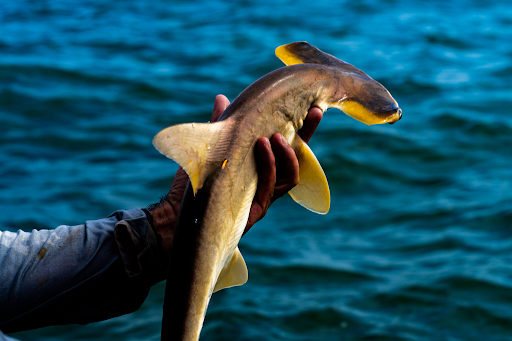
The scalloped bonnethead is a rare species of hammerhead found in the Eastern Pacific, from Mexico to Peru. It lives inshore at depths up to 100 m (328 ft). It’s also known to visit estuaries and mangroves.
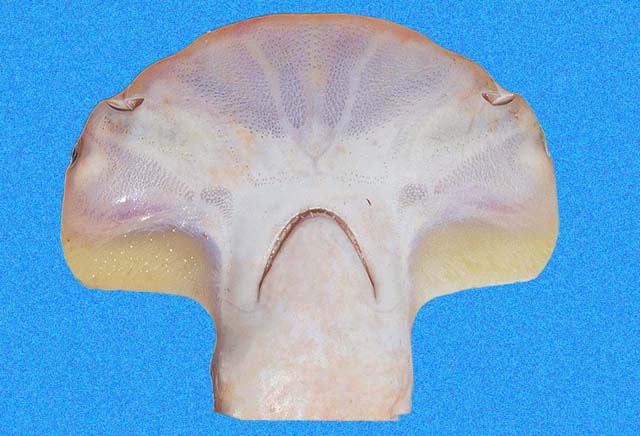
It is one of the smallest hammerhead species in the world, with adults only reaching up to 92 cm (36 in). They have a wide cephalofoil and an arched mouth, which is helpful for crushing molluscs and crustaceans. It is similar to the scoophead but scalloped bonnetheads have wider heads.
Scalloped bonnetheads are viviparous, meaning live birth, and have small litters of two pups.
Their numbers are low but there’s no evidence that they’re in decline. Other hammerheads with similar reproductive behaviours and biologies have been greatly overfished, so there is some concern about the long term health of this species.
It is captured in commercial and artisanal longlines and gillnets, and may also be caught in trawl fisheries, all of which are intense and largely unmanaged across much of its range. Although it has always been rare, records have become increasingly so over the decades since the 1950s; it is thought to be locally extinct in the Gulf of California and is overfished further south. There were nine records from all of Mexico between 1978 and 1994 and there have been none since. The situation is somewhat different in Colombia, where the species persists and is caught relatively frequently in artisanal catches. Fishing pressure is high there and it is suspected to have undergone a population reduction, although not as severe as that seen in Mexico. Overall, due to the known sensitivity of hammerhead sharks to overfishing, degradation of mangrove habitats, the level of intense and unmanaged fisheries across its range, its lack of refuge at depth, and the lack of recent records in Mexico (a large proportion of its range) despite fisheries-dependent and -independent surveys, it is inferred that the Scalloped Bonnethead has undergone a population reduction of >80% over the past three generations (24 years), and it is assessed as Critically Endangered A2bcd.
This shark is consumed or sold locally when captured (Mejía-Falla et al. 2017) and fins may be traded internationally. Although smaller fins were previously thought not to enter international trade, many smaller species have recently been observed in Hong Kong markets (Cardeñosa et al. 2019). This species is not named in that study, but the fins are likely to be similarly valuable to those of other congeners, such as the Bonnethead Shark (Sphyrna tiburo), that were present in samples.
There are no species-specific protections or conservation measures in place for the Scalloped Bonnethead. In the Mexican Pacific, there is a closed season for targeted elasmobranch fishing from May 1st to July 31st, but enforcement is inadequate (O. Sosa-Nishizaki unpubl. data 2019). A temporal ban of shrimp trawl fisheries is established in Colombia (January to March) but enforcement is also inadequate (Mejía-Falla and Navia 2017). Additionally, targeted industrial fishing of sharks and rays is prohibited in Colombia, with set bycatch limits (up to 35% of bycatch in the national territory; Resolution 1743 of 2017); however, surveillance and compliance requires strengthening. Further research is needed on life history, population size and trends, and threats. To conserve the population and permit recovery, a suite of measures will be required which will need to include species protection, spatial management, bycatch mitigation, and harvest management, all of which will be dependent on effective enforcement.
CITES Appendix II listing adopted in 2023. This means that while the species is not necessarily threatened with immediate extinction, international trade is strictly monitored, controlled, and regulated via permits to ensure their survival.
Do you have images or videos of Scalloped Bonnetheads?
Submit them to [email protected].



Donate Now | Team Sharkwater Newsletter | Group Sales | Shark Database | #SharkFree
Contact Us | Press | Partners | Terms of Use | Privacy Policy
© 2026 Sharkwater Productions - The Truth Will Surface 🦈