


The Scoophead Hammerhead/Scoophead Shark is a little known hammerhead that can be found in tropical waters of the western Atlantic Ocean.
Biology and Behaviour
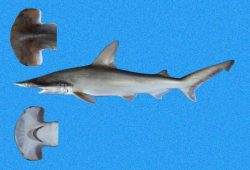
Scoopheads are the smaller species of the hammerheads reaching 150 cm (59 in) long. They are distinguished by their broad, mallet shaped head. The front margin of their head is arched, they have a shorter snout with a broadly arched mouth and a deep concaved anal fin. They are grey-brown in colour and lighter below.
Reproduction and Lifespan
Scoophead hammerheads are viviparous. Females mature at around 100 cm (39.4 in) long while males mature at a shorter length of 90 cm (35.4 in). Viviparous, meaning live birth.
Conservation and Tourism
It is captured in commercial and artisanal longlines and gillnets, which are typically unmanaged and operate throughout its range. It may also be caught in trawl fisheries. The declining numbers of records over the past several decades and range contraction in some areas indicates that this shark has undergone population reduction in both the Pacific and the Atlantic. In the Pacific, records have become increasingly rare and this species is no longer present in the Gulf of California. Records are sparse from elsewhere in Pacific Mexico and Central America and occur rarely in Colombia and Ecuador. The Atlantic South American portion of the population has also been reduced in size substantially. Off Caribbean Colombia, this species is considered rare. In Venezuela, it is subjected to intense and unmanaged fishing pressure, and it is suspected to have undergone population reduction there as a result of levels of exploitation. This situation is expected to be similar across the Guianas. Many elasmobranchs are at high risk of extinction in the north of Brazil, and it is suspected that this species has also been overfished there. There have been very sparse records in Bahia state; records of sphyrnid sharks there have been declining in number since the 1990s, and since 2000 have only occurred very rarely. There are no recent records from southern Brazil. Overall, this shark was formerly common or even abundant in the 1970s, has been and still is subjected to intense and largely unmanaged fishing pressure, as well as the degradation of mangrove habitats, and has undergone range retractions in some areas. There have been very few recent records and it is inferred that the Scoophead Shark has undergone a population reduction of >80% based on levels of exploitation, and it is assessed as Critically Endangered A2bcd.
Like other hammerheads, this shark is utilized for its meat and fins (Kato 1965, Mejía-Falla et al. 2017). Hammerheads are among the main shark species in the fin trade and are among the preferred species for shark fin soup. Although other larger congenerics are preferred in trade, it is likely that this species also enters the international market, as demand for smaller fins is increasing (Cardeñosa et al. 2019). The meat is likely consumed or sold locally, but may also be exported to Brazil where demand is rising (Dent and Clarke 2015).
There are no species-specific protections or conservation measures in place for the Scoophead Shark outside of Brazil. In the Mexican Pacific, there is a closed season for targeted elasmobranch fishing from May 1st to July 31st, but enforcement is inadequate (O. Sosa-Nishizaki unpubl. data 2019). In Brazil, it is listed in the Brazilian Ordinance of Ministry of the Environment Nº 445, which restricts all harvest and trade of species listed as Endangered or Critically Endangered on the Brazilian National Red List (Feitosa et al. 2018, Gadig et al. 2018). This legislation came into force in December 2014, however, it was suspended for all of 2015 and the first half of 2016 due to pressure from the fishing industry (Begossi et al. 2017). The ordinance faces increasing industry pressure, including a current court challenge to suspend the legislation again by the Secretaria Nacional de Aquicultura e Pesca (SAP), who brought forward their contention that the Brazilian National Red List was designed specifically for terrestrial species (Spautz 2019). A temporal ban of shrimp trawl fisheries is established in Colombia (January to March) but enforcement is also inadequate. Additionally, targeted industrial fishing of sharks and rays is prohibited in Colombia, with set bycatch limits (up to 35% of bycatch in the national territory and up to 5% in the Archipelago of San Andres, Providencia and Santa Catalina; Resolution 1743 of 2017); however, surveillance and compliance requires strengthening compliance (Mejía-Falla and Navia 2017).
It is listed under CITES Appendix II. This means that while the species is not necessarily threatened with immediate extinction, international trade is strictly monitored, controlled, and regulated via permits to ensure their survival.
Do you have images or videos of Scoop-head Hammerheads?
Submit them to [email protected].


Donate Now | Team Sharkwater Newsletter | Group Sales | Shark Database | #SharkFree
Contact Us | Press | Partners | Terms of Use | Privacy Policy
© 2026 Sharkwater Productions - The Truth Will Surface 🦈