


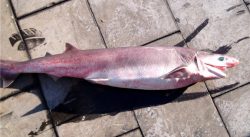
The sharpnose sevengill shark is a relatively uncommon species of cow shark found in deep water all over the world. It is an uncommon species but it’s widespread.
It feeds on pelagic fishes, squids and crustaceans. The maximum size it can grow up to is 140 cm (55 in). Males mature at 75 to 85 cm/29.5 to 33.5 in and females at 90 to 105 cm (35.4 to 41.3 in). They have a littler size of 6 to 20 with a size of 25 cm (9.8 in). The gestation and reproductive periodicity is unknown with other biological information. Ovoviviparous, meaning it produces young by means of eggs that hatch inside the mother’s body. The developing babies get their food from the egg yolk, not from the mother’s body, and are then born alive.
It is found in all tropical and temperate seas except Eastern North Pacific. It is captured at a depth of 300 to 600 m but they can dive up to a depth of 1,000 m (3,281 ft).
It is occasionally kept in captivity in Japan and behaves aggressively when captured. The species is utilised for human consumption, although the meat is considered of poor quality and has low market value (Ragonese et al. 2013). It is retained for its liver oil, presumably used for fish meal.
It occurs at places where commercial fisheries are likely to develop and has a low rate of multiplying and a poor resistance to depletion. These sharks are of minor importance but bycatch in bottom trawl and longline fisheries may have caused the decrease in its population. The increase in deepwater fishing pressure around the world may affect their population in the future.
The species is infrequently caught incidentally in pelagic, midwater, and deep-water industrial and artisanal fisheries across its range. There is distributional overlap with fishing pressure, reported and suspected declines in part of its range, and a lack of species-specific management across its entire range. The Sharpnose Sevengill Shark is suspected to have undergone a population reduction of 20–29% over the past three generations (41 years) based on abundance data and actual levels of exploitation, and is assessed as Near Threatened (close to meeting Vulnerable A2bd). There are no species-specific measures in place for the Sharpnose Sevengill Shark.
Do you have images or videos of Sharpnose Sevengill Sharks?
Submit them to [email protected].




Donate Now | Team Sharkwater Newsletter | Group Sales | Shark Database | #SharkFree
Contact Us | Press | Partners | Terms of Use | Privacy Policy
© 2026 Sharkwater Productions - The Truth Will Surface 🦈