


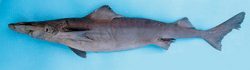
Seychelles gulper sharks are recently described and collected during a research cruise by a trammel net. They are deep-water sharks and distinguished by their long snout.
They can be seen in the Western Indian Ocean around the Seychelles island at about 1000 m (3,281 ft) underwater.
Biology and Behaviour
Seychelles gulper sharks are grey in colour, and their first dorsal fin is high and second dorsal fin base long which are blackened at the edges.
A fully grown female Seychelles gulper shark is 65 cm (25.6 in) in length, while males grow to 79 cm (31.1 in) long. Oviparous, meaning it lays eggs.
Reproduction and Lifespan
There is very little known about Seychelles gulper sharks in terms of their lifespan and reproduction activity.
Conservation and Tourism
It’s highly possible that Seychellois fishermen have caught Seychelles gulper sharks without knowing that these gulper sharks are a recently discovered species.
Seychelles gulper sharks are vulnerable to a declining population because of their small travel range and overfishing. There is some deep sea fishing near Seychelles, but there are no commercial fisheries that target sharks that swim below 600 m (1,969 ft).
No conservation methods are currently in place.
Given the species’ apparently narrow geographic and bathymetric range, and the limiting life history characteristics and general susceptibility of gulper sharks to rapid population depletion in fisheries, any bycatch is likely to be of significant concern. However, there are currently no deepwater fisheries operating off the Seychelles, and the population is suspected to be stable. The Seychelles Gulper Shark is therefore assessed as Least Concern. Further specimens are required to understand the species’ full distribution and life history. If fisheries expand deeper locally into the depth range of this species, it would likely deplete the population rapidly, and measures would need to be in place to mitigate interactions. This species is not known to be utilized or traded. CITES Appendix II listing adopted at CoP20 in December 2025 coming into effect in 2027. This means that while the species is not necessarily threatened with immediate extinction, international trade is strictly monitored, controlled, and regulated via permits to ensure their survival.
Do you have images or videos of Seychelles Gulper Sharks?
Submit them to [email protected].


Donate Now | Team Sharkwater Newsletter | Group Sales | Shark Database | #SharkFree
Contact Us | Press | Partners | Terms of Use | Privacy Policy
© 2026 Sharkwater Productions - The Truth Will Surface 🦈