


The Sharpfin Houndshark is a rare species of ground shark found in a limited region of Ecuador and hence is poorly known and distribution is uncertain. It was originally described 40 years ago from a specimen captured at Isla de la Plata. The only other known records are the landings from gillnet fisheries, but they are rare. Small-scale artisanal fisheries land houndsharks as bycatch, which has led to a reduction in their numbers.
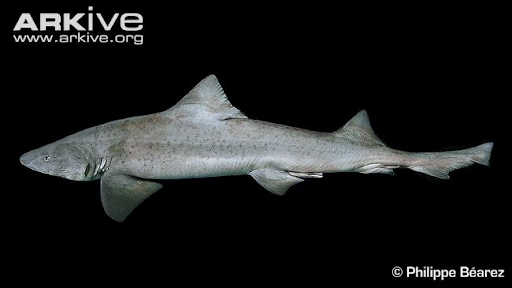
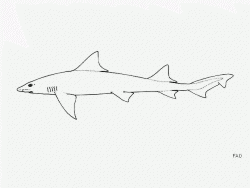
The Sharpfin Houndshark has an elongated and relatively robust body. The females usually grow up to 100 cm (39.4 in) and the males up to 90 cm (35.4 in). They feed on shrimps, crabs, and bony fishes. They usually are found on the bottom in the water column position and near coral reefs, rocks, soft bottoms like mud, sand gravel, beach. They’re ovoviviparous, meaning it produces young by means of eggs that hatch inside the mother’s body, but litter size is unknown.
In recent years, houndsharks have been found to decline in the bycatches. The shark’s extent of occurrence is less than 5,000 km² (1,931 mi²). A calculation of catches and sampling of inshore fisheries would help us determine its exact extent of occurrence.
There are limited records and specimens of this species.
Small-scale fisheries which catch sharks operate across coastal Ecuador and the Sharpfin Houndshark is reportedly caught very rarely in coastal artisanal demersal gillnet fisheries and the industrial hake demersal longline fishery that operates to a depth of 200 m (656 ft). Fishers interviewed in 2020 report catches as recent as ‘2010–2015’ in the artisanal gillnet fisheries. When caught, it is apparently discarded with only occasional local consumption of the meat. Its occurrence in Machalilla National Park (Isla de la Plata) could have significant conservation benefits for the species. However, given its rarity and restricted range, the Sharpfin Houndshark requires full legal protection and associated awareness and education.
It is known from a single location (Manabí province) affected by pressure from fisheries, and a continuing decline is inferred in the number of mature individuals based on the level of fishing effort across its range. The population size for this species is considered to be <2,500 individuals, based on very few records of it within a restricted area (with no evidence for genetically or geographically distinct subpopulations). The Sharpfin Houndshark is therefore assessed as Endangered B1ab(v); C2a(ii).
Houndsharks (‘tollo’) are heavily utilised in the Eastern Pacific for their meat and fins. However, recently interviewed fishers indicated that the Sharpfin Houndshark has hard skin making it difficult to process and is therefore generally discarded when caught with only occasional local consumption of the meat (Cevallos-Garcias et al. submitted).
Machalilla National Park encompasses Isla de la Plata (the type locality of the Sharpfin Houndshark) with a 2-mile (3.2 km) no-take zone around the island established in 2016. Interviews of local fishers are required across coastal provinces of Ecuador to understand where the species occurs (Cevallos-Garcias et al. submitted). Directed field surveys should be undertaken in Manabí province focusing on Isla de la Plata and coastal communities where fishers indicate the species has been caught in the past (Cevallos-Garcias et al. submitted). Its occurrence in Machalilla National Park could have significant conservation benefits for the species. Given its rarity and restricted range, the Sharpfin Houndshark requires full legal protection and associated awareness and education. To conserve the population and to permit recovery, a suite of additional measures will be required which may include spatial management, bycatch mitigation, and harvest and trade management measures (including international trade measures). Effective enforcement of measures will require ongoing training and capacity-building (including in the area of species identification). Catch monitoring is needed to help understand population trends and inform management.
Do you have images or videos of Sharpfin Houndsharks?
Submit them to [email protected].


Donate Now | Team Sharkwater Newsletter | Group Sales | Shark Database | #SharkFree
Contact Us | Press | Partners | Terms of Use | Privacy Policy
© 2026 Sharkwater Productions - The Truth Will Surface 🦈