


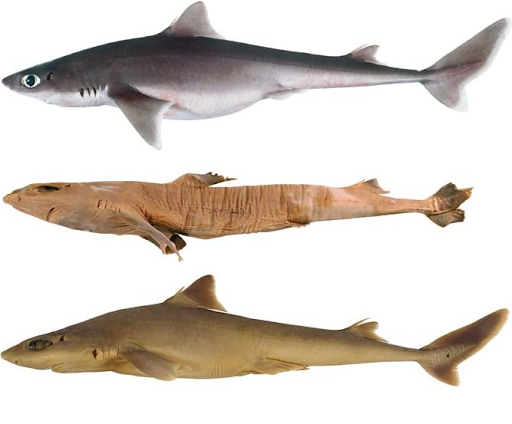
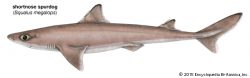
The short-nose spurdog is a species of dogfish found in temperate and tropical waters around in world. It’s most common off the coast of western and southern Africa, as well as southern Australia and South East Asia. They are found at depths of up to 732m/2,401.6 ft and their diet consists of bony fishes, crustaceans, molluscs and cephalopods.
They’re ovoviviparous, which means animals that develop inside eggs that hatch inside the mother’s body, leading to a live birth. and their litter sizes range from 1 to 6 pups. The gestation period is thought to be around two years and pups are 23-25cm/9.1 in to 9.8 in at birth. Males mature at between 34cm and 51cm/1 ft 1.4 in to 1 ft 8.1 in and females mature between 37cm and 62cm/1 ft 2.6 in to 2 ft 0.4 in. The maximum total length for this species is 77cm/2 ft 6.3 in.
Due to their abundance they are heavily fished in certain areas by trawling fisheries and with mesh nets. In Australia they are sold for human consumption but their small size does offer them a certain level of protection from larger gillnets. There isn’t currently enough information to assess their population health.
It is taken as target and bycatch by commercial trawl, Danish seine, gillnet, and longline. The species is one of the most abundant chondrichthyan species on the outer continental shelf and upper slope of southern Australian waters and is a major component of the chondrichthyan bycatch off parts of southeast Australia. Monitoring of catch rates in this area indicate increasing catch rates and no significant declines to date. It is a minor component of the discarded bycatch of the Queensland deep-water prawn trawl fishery and target and bycatch in the demersal gillnet fisheries through Bass Strait, off South Australia, and Western Australia. There have been no detectable changes in catch rates of this species by commercial shark gillnets in Bass Strait since the 1970s and no apparent declines in Western Australia. There are large areas of its range that are either lightly fished or unfished. Due to the increasing and stable catch rates and the large areas that are unfished or lightly fished, the species in not suspected to be close to reaching the population reduction threshold and is assessed as Least Concern.
The Shortnose Spurdog is used for human consumption domestically where it is sold as fresh fillets. ‘Greeneye dogfish’, which is comprised of about 80% Shortnose Spurdog, was sold through the Sydney Fish Market but sales declined during the 1990s from about 150 tonnes in 1992 to about 50 tonnes in 1999 (Daley et al. 2002), with lesser quantities likely sold since due to general reductions in catches of deep-water sharks since the late 1990s. Quantities sold in other Australian markets are likely to be small.
There are currently no conservation measures in place for this species. There are total allowable catches (TACs) for deep-water sharks (including Shortnose Spurdog) in the Southern and Eastern Scalefish and Shark Fishery (SESSF).
Do you have images or videos of Short-nose Spurdogs?
Submit them to [email protected].


Donate Now | Team Sharkwater Newsletter | Group Sales | Shark Database | #SharkFree
Contact Us | Press | Partners | Terms of Use | Privacy Policy
© 2026 Sharkwater Productions - The Truth Will Surface 🦈