


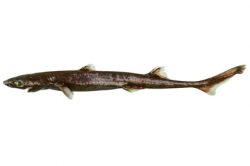
The short-tail lanternshark is a species of dogfish shark found around Western and Northern Australia, Japan, and Philippines. Like all lanternsharks, they’re small deep water sharks known for the light-producing photophores on their bodies. The photophores are concentrated mostly on their belly and it works as counter illumination, making the shark seem brighter to match their backgrounds. This makes it easier for the lanternshark to stalk prey. They feed on small fish and invertebrates.
They’re presumably viviparous, meaning live birth. With litter sizes ranging from 5 to 13 young. Pups are born about 12 cm/4.7 in long, become mature at 33-40 cm/1 ft 1.0 in to 1 ft 3.7 in , and grow to a maximum length of 50 cm/1 ft 7.7 in.
Short-tail lanternsharks have been recorded at depths of 450 to 900 m/1,476.4 to 2,952.8 ft.
The species may be caught incidentally in deepwater fisheries but its small size may reduce its catchability and deepwater fishing effort across much of its range has been reduced. Further information is required on its distribution, ecology, and life history, and interactions with fisheries should be monitored. At this time, global population trend is suspected to be stable based on refuge in deep water outside of current fishing activities and the Short-tail Lanternshark is assessed as Least Concern.
Fisheries targeting deepwater sharks across its distribution, including fisheries operating off the Philippines have targeted larger, more valuable species such as gulper sharks (Centrophorus spp.) and spurdogs (Squalus spp.), although some larger unidentified lanternsharks (>50 cm TL) have been reported at landing sites as well (Flores 2004, LAMAVE 2017). In Japan, bottom trawl fisheries effort has decreased markedly over the last three decades and is continuing to decline, mostly due to the significant decline in the numbers of fishers and vessels participating in the fishery as fishers age and a lack of young people move into the industry (NFMT 2017, FAO 2019). There is limited fishing effort off western and eastern Australia where the species may be occasionally be caught as bycatch (Simpfendorfer and Rigby 2023). This species is not known to be utilized.
There are no species-specific measures in place for the Short-tail Lanternshark. In Australia, the Short-tail Lanternshark is managed in the Southern and Eastern Scalefish and Shark Fishery using a basket quota for deepwater sharks, however, the species makes up a very small proportion of the catch of this basket group (AFMA 2021). Further information is required on its distribution, ecology, and life history, and interactions with fisheries should be monitored.
Do you have images or videos of Short-tail Lanternsharks?
Submit them to [email protected].


Donate Now | Team Sharkwater Newsletter | Group Sales | Shark Database | #SharkFree
Contact Us | Press | Partners | Terms of Use | Privacy Policy
© 2026 Sharkwater Productions - The Truth Will Surface 🦈