


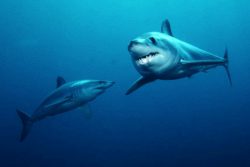
The Shortfin Mako Shark, sometimes known as the Blue Pointer, is the fastest shark in the world, capable of speeds of up to 68km/h, 42.3 mph. They are found globally in temperate and tropical waters. The name ‘Mako’ comes from the Maori word for shark or shark tooth.
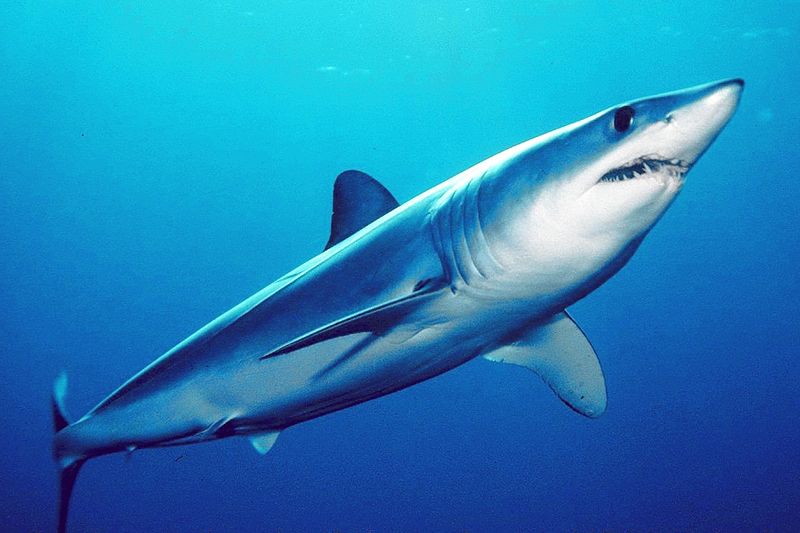
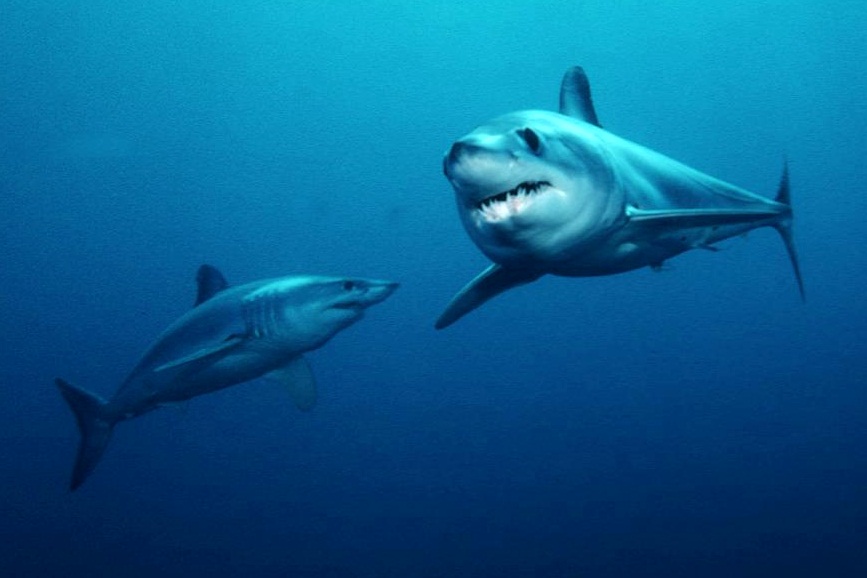
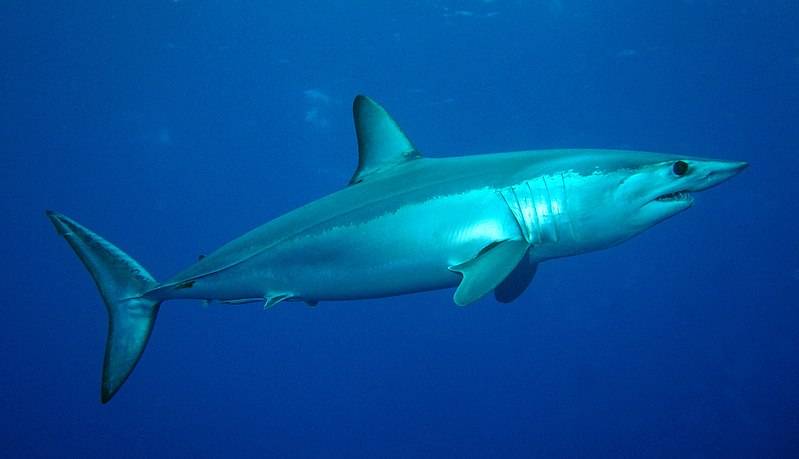
Shortfin Mako Sharks are a bright metallic blue dorsally with a white underside. They have a cylindrical body and a vertically elongated tail. The average adult measures 3.2m/10 ft 6.0 in in length, with some females growing to over 3.8m/12 ft 5.6 in. The longest ever specimen was caught off the coast of France in 1973 and measured an incredible 4.45m/14 ft 7.2 in. The maximum age for Shortfin Makos is 29 years for males and 32 years for females.
Shortfin Mako Sharks are rarely found close to land and are known to travel great distances to feed and to mate. In December 1998, a female tagged in California was found in the central Pacific, meaning it travelled around 2,776 km/1,724.9 miles. They are rarely found in waters below 16c and they are one of four species of shark known to be endothermic, meaning that they are able to regulate their body temperature to keep it higher than the water temperature around them. Their ability to reach high speeds, which enables them to jump up to 9ft/2.74 m out of the water, has been attributed partially to their endothermic nature.
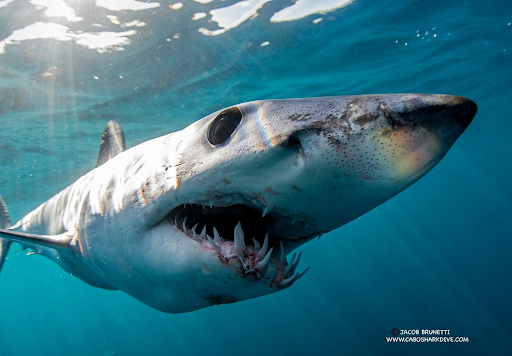
The diet of the Shortfin Mako consists primarily of cephalopods and bony fish, like tunas and swordfish, but they have been known to eat other sharks, porpoises and sometimes seabirds. They usually swim below their prey and they suddenly lunge upwards whilst hunting. They consume around 3% of their body weight every day.
The Shortfin Mako produces a litter of between 4 and 18 pups every three years or so. Their reproduction is ovoviviparous, meaning that eggs hatch inside the uterus of the mother and develop internally until they are ready to be born. During the gestation period, which is usually 15 to 18 months, the pups are nourished by the yolk sacs of unfertilized eggs. Shortfin Mako pups are around 70cm/2 ft 3.6 in long at birth.
It is caught globally as target and bycatch in coastal and pelagic commercial and small-scale longline, purse seine, and gillnet fisheries, and is generally retained for the high-value meat as well as its fins. Steep population declines have occurred in the north and south Atlantic, with declines also evident, though not as steep in the north Pacific and Indian Oceans. The south Pacific population appears to be increasing but with fluctuating catch rates. The weighted global population trend estimated a median decline of 46.6%, with the highest probability of 50–79% reduction over three generation lengths (72–75 years), and therefore the Shortfin Mako is assessed as Endangered A2bd.
The species is generally retained for the meat and fins (Clarke et al. 2006a, Clarke et al. 2006b, Dent and Clarke 2015, Fields et al. 2017), unless regulations prohibit retention. Under-reporting of catches is likely in pelagic and domestic fisheries (Dent and Clarke 2015, Campana et al. 2016a). The species is highly valued by big-game recreational fishers, and although many practice catch and release, recreational fishing could be a threat due to post-release mortality, although such mortality is reported at 10% for recreational fishing (Camhi et al. 2008, French et al. 2015). Commercial post-release mortality has been reported as 30–33% for the Shortfin Mako on longlines (Campana et al. 2016b). The species is taken in beach protection programs that target large sharks (Dudley and Simpfendorfer 2006, Simpfendorfer et al. 2010, Reid et al. 2011).
This is one of the most valuable shark species due to its high-quality meat. The meat is utilized fresh, frozen, smoked, and dried-salted for human consumption. The fins of the Shortfin Mako are commonly traded, comprising 1.2% of the fin imported in Hong Kong in 2014 (Fields et al. 2017). The liver oil, jaws, and skin are also used (Compagno 2001).
The success of actions agreed through international wildlife and fisheries treaties depends on implementation at the domestic level; for sharks, such follow up actions have to date been seriously lacking. In 2008, the Shortfin Mako was listed on Appendix II of the Convention on Migratory Species (CMS), which reflects Parties’ commitments to work regionally toward conservation. The species is also covered by the CMS Memorandum of Understanding for Migratory Sharks, which is aimed at facilitating conservation. In 2018, Mexico announced its intention to propose adding the Shortfin Mako to Appendix II of the Convention on International Trade in Endangered Species (CITES). If the proposal is adopted at the 2019 CITES Conference, Shortfin Mako exports from CITES Parties would need to be accompanied by permits based on findings that parts are sourced from legal and sustainable fisheries.
Globally, there are very few limits on Shortfin Mako catch. In 2012, the General Fisheries Commission for the Mediterranean (GFCM) banned retention and mandated careful release for the Shortfin Mako and 23 other elasmobranch species listed on the Barcelona Convention Annex II. Implementation by GFCM Parties, however, has been very slow. Whereas the European Union implemented this measure through domestic regulations, it has yet to limit Shortfin Mako catch from anywhere else, even as Spain is consistently the world’s top Shortfin Mako fishing nation. A 2017 measure agreed by the International Commission for the Conservation of Atlantic Tunas (ICCAT) – in response to scientific advice to ban retention of overfished north Atlantic Shortfin Makos – instead aims to maximize live release by narrowing the conditions under which Shortfin Makos from this population can be landed.
To allow recovery, it is recommended Shortfin Mako landings be prohibited as long as the global population is classified as Endangered. Short of that, improved reporting of catch and discard data, regional and national limits on Shortfin Mako catch based on scientific advice and/or the precautionary approach, and promotion of safe release protocols are urgently needed, as is full implementation of additional commitments agreed through international treaties.
Do you have images or videos of Shortfin Mako Sharks?
Submit them to [email protected].


Donate Now | Team Sharkwater Newsletter | Group Sales | Shark Database | #SharkFree
Contact Us | Press | Partners | Terms of Use | Privacy Policy
© 2026 Sharkwater Productions - The Truth Will Surface 🦈