


The Silvertip shark is both an inshore and offshore shark found over or adjacent to continental, insular shelves and offshore banks, and are associated with coral reefs. Native to the tropical Indo-Pacific, it is found in areas like the Red Sea and East Africa, including Madagascar, Seychelles, Aldabra Group and Mauritius. The Silvertip shark is utilized for its fins, meat, skin and cartilage. Its population is decreasing due to it being subjected to bycatch in high seas fisheries and in artisanal longline, gillnet, and trawl fisheries throughout its range.
Biology:
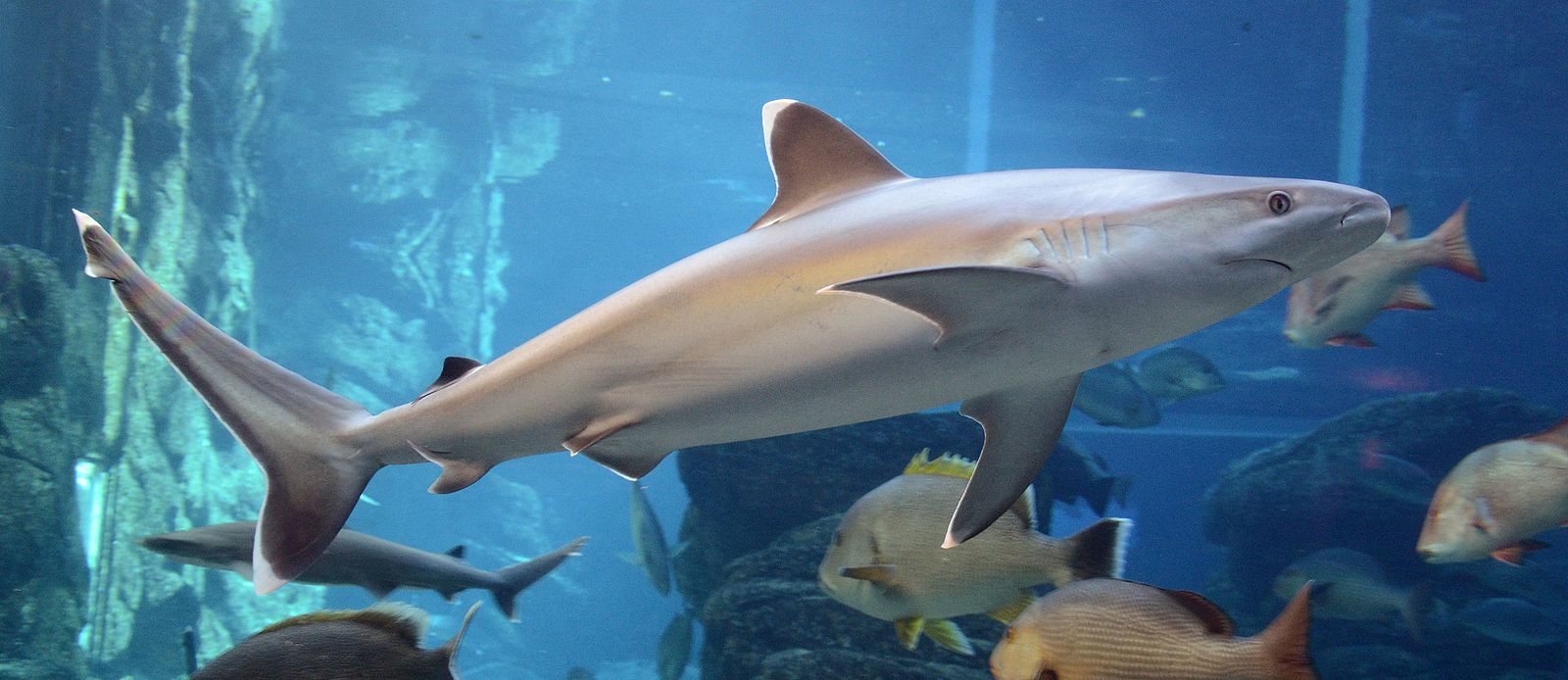
All the fins on the Silvertip shark have distinctive visible white tips. Their eyes have a tapetum lucidum, enabling them to see in dark murky waters and to see up to 10 times more accurately than humans in clear water. They also have a well-developed sense of hearing as well as a strong sense of smell enabling them to detect trace amounts of blood. The max length of a Silvertip shark ever recorded was 300 cm/9 ft 10.1 in long, while the common length of this species is about 200 cm/6 ft 6.7 in. They can also weigh up to 162.2kg/357.6 lbs.
Reproduction:
Silvertips give birth to live young that have developed inside the body like other requiem sharks. After a 12 month period of development, mothers give birth to up to 11 young with the young reaching from 50 to 60cm/1 ft 7.7 in to 1 ft 11.6 in in length.They become sexually mature when they’re about 160 to 200 cm/5 ft 3.0 in to 6 ft 6.7 in long.
Behaviour
This species prefers offshore islands, coral reefs and banks. They live and feed on or near the bottom of the body of water and occupy the ocean floor in coastal waters and near the continental slopes and rises. They feed on midrange fish like mackerel, rays and other small sharks and are found at a depth range from 1 – 800m/3.3 to 2,624.7 ft. The Silvertip shark can be aggressive when threatened.
Threats
The Silvertip Shark is caught globally as target but mostly incidental catch in industrial, artisanal, and subsistence fisheries with pelagic longlines and purse seines, gillnet and demersal trawl, and a range of artisanal gear. It is generally retained for the meat and large fins (Ebert et al. 2021). Its migratory behaviour from the seafloor to shallow waters at night increases its susceptibility to capture in the pelagic tuna fisheries.
The Silvertip Shark is used for its fins, meat, cartilage, liver, teeth, jaws, and skin (SEAFDEC 2006, Asbury et al. 2021, Ebert et al. 2021). The meat, teeth, and jaws are generally sold locally, whereas fins, skin, and cartilage are generally exported. The species is a relatively small component of the international fin trade, accounting for 0.35% and 0.10–0.13% of sampled fins traded in China and Hong Kong, respectively (Fields et al. 2018, Cardeñosa et al. 2020).
Conservation
Currently there are no species-specific management measures in place. The Silvertip Shark is prohibited from targeted take in approximately 13% of the countries across its range, that is, those in which a ‘Shark Sanctuary’ has been declared and in other Marine Protected Areas (MPAs), such as the Chagos Archipelago and within MPAs of, for example, Australia and South Africa (Cardeñosa et al. 2022, Faure-Beaulieu et al. 2023). There are many general management measures that contribute to conserving this species in many range states. Marine Protected Areas that incorporate >20 km of coral reef can provide significant protections because of the limited movements observed in this species (Dwyer et al. 2020). Marine Protected Areas are common in coral reef areas throughout its range, but only those that are sufficiently large and well enforced provide refuge (MacNeil et al. 2020).
Do you have images or videos of Silvertip sharks?
Submit them to [email protected].





Donate Now | Team Sharkwater Newsletter | Group Sales | Shark Database | #SharkFree
Contact Us | Press | Partners | Terms of Use | Privacy Policy
© 2026 Sharkwater Productions - The Truth Will Surface 🦈