


The Slender Bamboo Shark is a bamboo shark in the family Hemiscylliidae, found in the Indo-West Pacific Oceans.
Biology and Description:
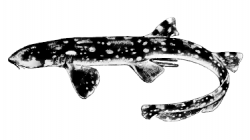
The Slender Bamboo Shark has a mouth located in front of the eyes. Has an elongated precaudal tail. The dorsal fins are round, same size, and smaller than the pelvic fins. This shark is of a brownish color with a number of dark spots and dashes. This species reaches a maximum size of 65 cm (2 ft 2 in) TL with males maturing at 39 (1 ft 3 in) and 42 cm (1 ft 5 in) TL and females at 43 cm (1 ft 5 in) TL. It is oviparous, deposits eggs in small, oval egg cases at the bottom. Paired eggs are laid. Embryos feed solely on the yolk. Feeds on bottom-dwelling invertebrates, and also small fishes.
Habitat:
The Slender Bamboo Shark is a fresh-water, demersal shark, but little-known slugging bottom shark. It is found on sandy and muddy bottoms of coastal waters, bays and inlets, and rocky coral reefs. This shark’s distribution is uncertain but mainly occurs in the Indo-West Pacific Oceans from the Arabian Sea to India, Sri Lanka, Singapore, Thailand, Indonesia, Vietnam, Taiwan and the Solomon Islands. Probably occurring in Japan and Korea.
Conservation:
The Slender Bamboo Shark is of considerable interest to fisheries in some areas and is regularly taken in inshore fisheries in India, Sri Lanka, and Thailand and utilized fresh for food. In Bangladesh, species of the genus Chiloscyllium are often landed and sold to crocodile farmers as animal feed. There are currently no conservation measures in place for this species.
The species is a bycatch of a range of artisanal and industrial gears including demersal trawl, longline, and gillnet and is retained for human consumption. Reconstructed catches of all sharks, skates, and rays from the Bangladesh, Malaysia, Viet Nam, and China Exclusive Economic Zones indicate declines of 27–88% over the past three generation lengths (18 years) of the Slender Bambooshark. Further, a population reduction of 31% was inferred for the Slender Bambooshark based on a 50% decrease in fisheries-independent research survey catch rate of elasmobranchs (all species combined) between 1978–80 and 2013 in Myanmar. These levels of declines are not species-specific but are informative for understanding the broader levels of decline of elasmobranchs in the region. Fishing pressure is high across much of the spatial and depth range of this species yet it is still commonly landed in parts of its range. The relative proportion of bamboosharks in shark landings has increased significantly over recent decades in the region, which may be in response to the overfishing of large sharks resulting in meso-predator release of the Slender Bambooshark. Alternatively, the increase in landings may imply some resilience to, or refuge from, fishing pressure. The rocky habitat and inshore and seasonal trawl bans in China may afford the species some refuge from fishing pressure. It is suspected that the Slender Bambooshark has undergone a population reduction of 30–49% over the last three generation lengths (18 years) due to levels of exploitation, and it is assessed as Vulnerable A2d.
Do you have images or videos of Slender Bamboo Sharks?
Submit them to [email protected].


Donate Now | Team Sharkwater Newsletter | Group Sales | Shark Database | #SharkFree
Contact Us | Press | Partners | Terms of Use | Privacy Policy
© 2026 Sharkwater Productions - The Truth Will Surface 🦈