


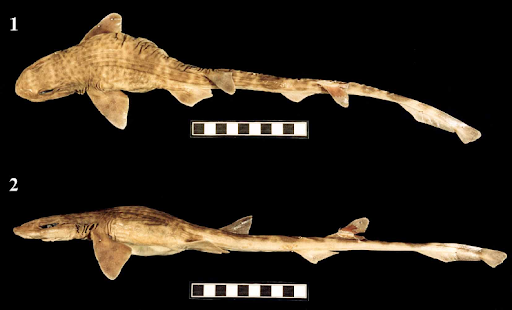
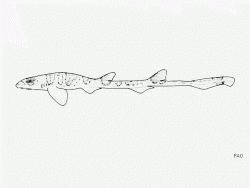
The slender catshark is a species of ground shark found in the Western Atlantic, off the coast of Brazil and Suriname, including the Amazon estuary. They live at the bottom at depths of 70 to 400 m/229.7 to 1,312.3 ft. Like all members of the catshark shark family, they’re bottom feeders, have elongated cat-like eyes, and two small dorsal fins set far back. They’re mostly nocturnal and often sleep in groups during the day.
Their dorsal side is pale brown or grey and have seven or eight dark saddle-shaped patches. They’re opportunistic hunters and eat everything from bony fishes and other sharks to mollusks and sponges.
They’re oviparous, meaning they lay eggs, and lay one or two eggs at a time. The grow to a maximum length of 70 cm/2 ft 3.6 in.
The Slender Catshark is captured by demersal trawl fisheries. There are deep-water fisheries in Suriname and French Guiana that target shrimp and snapper, but fleets are small and most trawling there occurs on the continental shelf (Harper et al. 2015, Garstin and Oxenford 2018). In northern Brazil, demersal trawling is intense but typically only occurs to a depth of 200–250 m (P. Charvet unpubl. data 2018) and likely only interacts with a portion of the population. Although this catshark is subjected to fishing pressure in the upper portion of its depth range, it has a substantial refuge at depth over at least two thirds of its range.Most of its depth range is beyond the reach of fisheries. It is suspected that this species’ population is being reduced, but not to levels approaching thresholds for a threatened assessment. Therefore, the Slender Catshark is assessed as Least Concern.
This catshark is not known to be utilized or traded, and is likely to be discarded when caught due to its small size.There are no species-specific protections or conservation measures in place for this shark. Further research is needed on distribution, life history, and population size and trends. Bycatch should be monitored to the species level, and any expansion of fisheries into deeper water should be monitored to ensure they don’t begin to pose a risk to this species.
Do you have images or videos of Slender Catsharks?
Submit them to [email protected].


Donate Now | Team Sharkwater Newsletter | Group Sales | Shark Database | #SharkFree
Contact Us | Press | Partners | Terms of Use | Privacy Policy
© 2026 Sharkwater Productions - The Truth Will Surface 🦈