


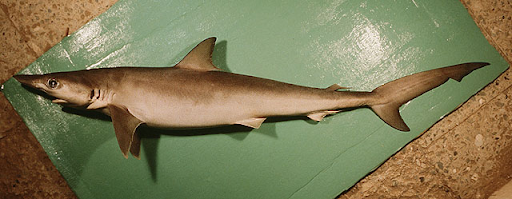
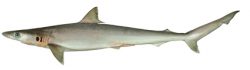
The Slit-eye Shark is species of requiem shark, in the family Carcharhinidae, and only member of its genus Loxodon. It is found in the Indo-West Pacific.
This is a small species of shark. They mature around 60 cm/1 ft 11.6 in TL, and grow to a maximum size of 90 cm/2 ft 11.4 in TL. The young are born at 40 to 45 cm/1 ft 3.7 in to 1 ft 5.7 in TL, they reproduce annually and usually have a litter size of two and are viviparous, giving birth to live young.. They feed on teleost fish, crustaceans and cephalopods.
This species is a marine demersal shark, found on continental and insular shelves, mainly near the bottom. It occurs almost continuously from eastern South Africa to southern Japan and Northern Australia.
There are no conservation measures currently in place for this species.
The species is captured as bycatch and occasionally targeted, in industrial and small-scale fisheries by multiple fishing gears including trawl, gillnet, and line, and is retained for its meat, and to a lesser extent for its fins. The population is suspected to be declining across most of its range except for within Australia where there is likely a stable population due to the low to moderate managed fishing pressure. Although the Sliteye Shark is a productive species which likely increases its resilience to fishing pressure, it is subject to historic and ongoing intense fishing pressure across its spatial and depth range. It is still common in parts of its Arabian Seas and Southeast Asia regions but has also declined and is now uncommon in other parts of those regions.
The species is used for its meat which is often consumed fresh but also dried and salted for domestic sales or trade with neighbouring countries. Fins are not considered valuable due to their small size but are still traded internationally.
In Australia, fisheries are well regulated with limited entry, catch or effort limits, gear restrictions, finning regulations, and size limits. Throughout much of the rest of the Sliteye Shark’s range there are few effective regulations that limit the take of this species. Several nations within its range have general regulations that apply to sharks, and the marine protected areas in parts of its range may provide some benefit to the species. Further research is needed on population size and trend, and life history, and catch rates should be monitored.
Do you have images or videos of Slit-eye Sharks?
Submit them to [email protected].


Donate Now | Team Sharkwater Newsletter | Group Sales | Shark Database | #SharkFree
Contact Us | Press | Partners | Terms of Use | Privacy Policy
© 2026 Sharkwater Productions - The Truth Will Surface 🦈