


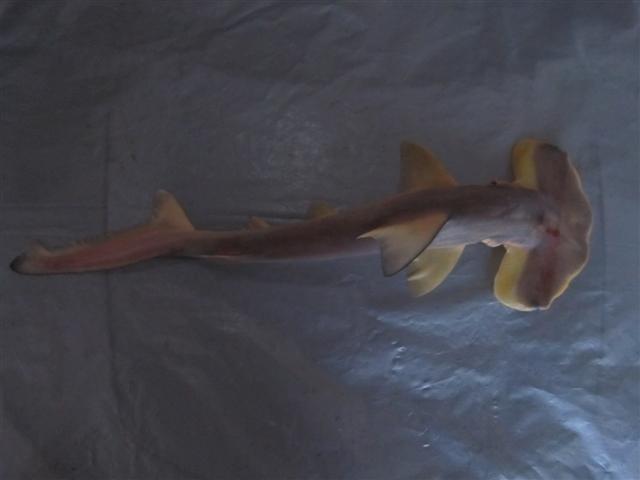
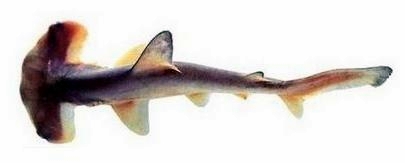
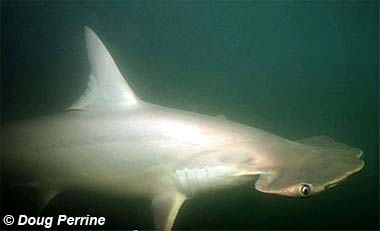
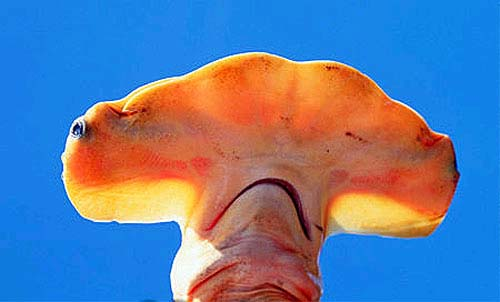
The Sphyrna Tudes Shark, also known as the Golden Hammerhead Shark, the Smalleye Hammerhead Shark or the Curry Shark, is a small species of Hammerhead shark, belonging to the Sphyrnidae Family.
Biology:
Off Trinidad, males mature at 80 cm/2 ft 7.5 in TL; females at 98 cm/3 ft 2.6 in TL, however, the estimated size at 50% maturity for females was 114 cm/3 ft 8.9 in TL. The reported size at birth is of 30 cm/11.8 in TL. The characteristic golden colour of live specimens results from a pigment present in their penaeid shrimp and ariid catfish diet.
Reproduction:
Like all hammerheads shark, this species is viviparous, meaning giving birth to live young that develop inside the mother’s body, rather than hatching from eggs. This species has a one-year reproductive cycle with litters of 5 to 19 pups. Given its inshore coastal habitat, limited reproductive capacity, this species is susceptible to capture and heavy gillnet fishing pressure throughout its range. Females are reported to ovulate and mate during August, following a 10-month gestation the young are born in shallow water from late May to June.
Habitat:
The Smalleye Hammerhead Shark is found along the eastern coast of South America from Uruguay to Venezuela. This species inhabits inshore murky waters 5-40m/16.4 to 131.2 ft deep, over muddy bottoms. There is segregation by sex and age; newborns and juveniles under 40 cm /1 ft 3.7 inTL are found in shallowest waters, moving deeper after a few months of life. Adult females are mostly found at depths of 9 – 18 m/29.5 to 59.1 ft. Larger juveniles and adult males are mostly found at depths of 27 – 36 m/88.6 to 118.1 ft.
Conservation:
The Smalleye Hammerhead is captured in commercial and artisanal beach seines, gillnets, longlines, and trawls. Artisanal fisheries are intense across much of coastal Atlantic South America, and there are largely unmanaged commercial trawl and longline fisheries in many areas. In Caribbean Colombia, artisanal fisheries are widespread and lack management, and there is also a shallow-water shrimp trawl fishery for which stocks have been significantly reduced. This shark is targeted or retained as bycatch for its meat, which is consumed or sold locally. There are few data on population reduction but these intensive unmanaged fisheries are suspected to have caused reductions and possibly local extinctions throughout this species’ range. For example, in Brazil, this hammerhead has not been recorded in 35 years from Ceará state and it is considered by local fishers to be depleted in Bahia state. This shark is supposed to be strictly protected in Brazil, but it is clear that it is still landed and traded in various states. Overall, due to intense and largely unmanaged fisheries across its range, lack of refuge at depth, suspected declines in many areas and local extinctions suspected from an absence of records (despite continued sampling and observation), and its relatively unproductive life history, it is suspected that the Smalleye Hammerhead has undergone a population reduction of >80% over the past three generations (37 years), and it is assessed as Critically Endangered A2bd.
Hammerheads are among the main shark species in the fin trade and are among the preferred species for shark fin soup. Although other larger congeners are preferred in trade, it is likely that this species also enters the international market, as demand for smaller fins is increasing (Cardeñosa et al. 2019). The meat is likely consumed or sold locally, but may also be exported to Brazil where demand is rising (Dent and Clarke 2015). In Colombia, it is consumed by Indigenous communities (Puentes-Cañón et al. 2012).
23 February 2023 it was listed on Appendix 11 on Cites, which requires export permits to ensure sustainable trade.
Do you have images or videos of Small-eye Hammerheads?
Submit them to [email protected].



Donate Now | Team Sharkwater Newsletter | Group Sales | Shark Database | #SharkFree
Contact Us | Press | Partners | Terms of Use | Privacy Policy
© 2026 Sharkwater Productions - The Truth Will Surface 🦈