


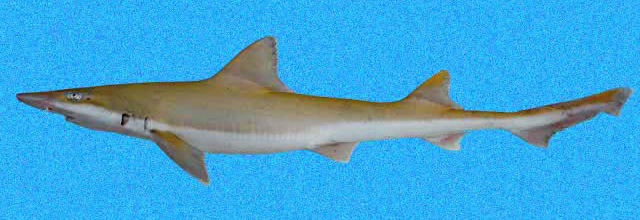
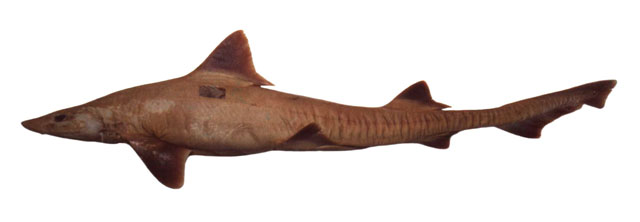
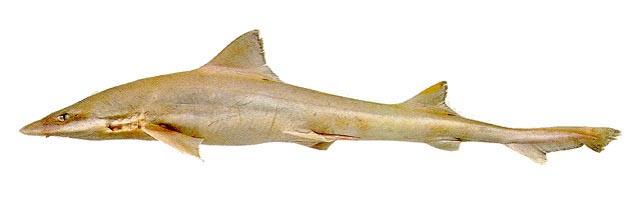
Smalleye smoothhounds can be found in the western Atlantic Ocean at depths between zero to 900 m/0 to 2,952.8 ft on muddy, sandy and calcareous bottoms.
Biology and Behaviour
Smalleye Smoothhounds can grow up to 70 cm/2 ft 4 in, but are commonly 55 cm/1 ft 9.7 in long. They mainly feed on crustaceans and sometimes will prey on bony fishes, squids and coelenterates.
Reproduction and Lifespan
Smalleye smoothhounds are viviparous with a litter size between one to seven pups. Females give birth during the summer months in Brazil (December to February). They are presumably a fast growing species. Pups are between 21.6 to 22.9 cm/8.5 to 9.0 in long at birth, then female smalleye smoothhounds mature at 42.5 cm/1 ft 4.7 in long and males at 47.5 cm/1 ft 6.7 in long.
Conservation and Tourism
The IUCN lists smalleye smoothhounds as
Endangered, reflecting substantial population declines associated with fishing pressure. Its relatively restricted range means heavy fishing in individual countries can have a substantial effect on the overall population.
The species is commercially caught and is particularly vulnerable to bottom trawling, gillnets, artisanal fisheries, other demersal fishing.
Smooth-hounds are often retained for their meat and fins rather than being discarded as unwanted bycatch. Artisanal fisheries are intense across much of coastal Atlantic South America, and there are largely unmanaged commercial trawl and longline fisheries in many areas. For example, in Venezuela, commercial and artisanal fisheries are intense, lack management, and have exhibited peaks in catches followed by declines, indicative of sequential overfishing. This shark is targeted in gillnets and longlines there on offshore islands, where it makes up 40% of the shark catch by number. It is suspected that this shark has undergone a population reduction of 50–79% over the past three generation lengths (32 years).
Do you have images or videos of Small-eye Smooth-hounds?
Submit them to [email protected].



Donate Now | Team Sharkwater Newsletter | Group Sales | Shark Database | #SharkFree
Contact Us | Press | Partners | Terms of Use | Privacy Policy
© 2026 Sharkwater Productions - The Truth Will Surface 🦈