


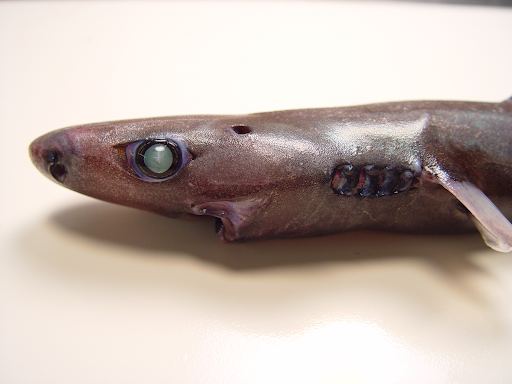
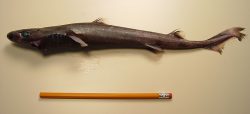
The smooth lanternshark is a species of lantern shark found in the Indian, Atlantic, and Pacific Oceans at depths of up to 1070 m/3,510 ft. Like all members of the lantern shark family they’re small, with a maximum length of 50 cm/1 ft 7.7 in, they live in deep water, and have light-producing photophores on their body. These photophores are just bright enough to mask their silhouette and make them look invisible from below. This allows them to sneak up on prey.
Smooth lanternsharks are ovoviviparous. The embryos develop in eggs inside of the mother until they’re ready to hatch. Litter size ranges from 8 to 18 eggs. Pups are born about 13 cm (5.1 in) long, become mature at 40 cm (1 ft 4 in), and grow to a maximum length of 50 cm/1 ft 7.7 in. Their diet consists of small fishes, squid, and fish eggs.
Their name comes from their denticles, which are widely separated and gives them a smooth appearance. They’re very similar, although smaller, to the blurred lanternshark.
They’re caught as by-catch by deep water fisheries, but have little commercial value. Their found around the world and live at depths inaccessible to most fisheries. Species-specific management actions are established across its range in the Northeast Atlantic, and the species is likely to have refuge at depth from fishing activities in parts of its range. The species is not suspected to be close to reaching the population reduction threshold. Their conservation status is currently Least Concern, but the expanding deep water fisheries must be monitored.
The Smooth Lanternshark is occasionally taken as bycatch in demersal and midwater trawl, demersal longline, and trammel net fisheries across much of its range. Its peak abundance occurs ~400 m depth (Moura et al. 2018), well within the depth range of deep-water fishing activities (Victorero et al. 2018). When reported, the Smooth Lanternshark is generally reported in small quantities (e.g. Akhilesh et al. 2011, Francis 2015, da Silva et al. 2015, Pajuelo et al. 2016, Frietas et al. 2018, Facounnet et al. 2019). In the Northeast Atlantic, Norway reported the largest catches of lanternsharks (Etmopterus spp.), reaching 129 t in 2017; most of the catch is discarded (ICES-WGEF 2018). Post-release mortality is unknown.
Across most of its range, there are no species-specific measures in place for the Smooth Lanternshark. Further information is required on population size and trends of the species, as well as interactions with fisheries across its range.
Since 2010, the European Union Fisheries Council has prohibited direct fishing for deep-water sharks, including the Smooth Lanternshark, in European Community and international waters, and in 2012, no allowances for bycatch were implemented (ICES-WGEF 2018). In 2017 and 2018, a restrictive bycatch allowance (10 t) was trialled, permitting limited landings of unavoidable catches of deep-water sharks in directed artisanal demersal longline fisheries for Black Scabbardfish (Aphanopus spp.). Additional management actions for this region include banned use of trawls and gillnets in waters >200 m in Azores, Madeira and Canary Islands and international waters regulated by ICES (NEAFC regulatory Area); banned use of gillnets by EU vessels at depths >600 m; maximum bycatch limits of deep-water shark in Hake (Merluccius merluccius) and Monkfish (Lophius spp.) gillnet catches; area restrictions by vessel size and gear, gear restrictions (hook size, maximum number of hooks on longline gear), and a network of closed areas in Azorean waters; closure of the Condor seamount to deep-water fishing in 2010 (ICES-WGEF 2018).
Do you have images or videos of Smooth Lanternsharks?
Submit them to [email protected].


Donate Now | Team Sharkwater Newsletter | Group Sales | Shark Database | #SharkFree
Contact Us | Press | Partners | Terms of Use | Privacy Policy
© 2026 Sharkwater Productions - The Truth Will Surface 🦈