


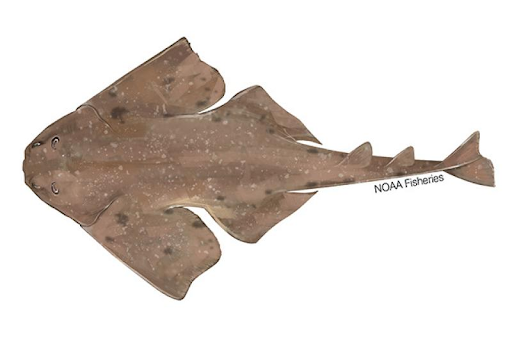
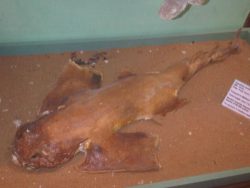
The Smoothback Angelshark is found in warm-temperate and tropical waters in the eastern Atlantic and the Mediterranean. This shark is categorised as Critically Endangered by the ICUN and much of the Mediterranean population has disappeared. They are usually found at depths ranging from 5 to 500m.
The Smoothback Angelshark can grow to up to 160cm. They have prominent thorns on their nose and above their eyes and have large white spots on their body. They are ovoviviparous, meaning that females produce eggs but these remain within the uterus until the pups are ready to be born, usually between February and April. They produce between 3 and 8 pups per litter, and the pups are around 24-27cm at birth. The longevity of the Smoothback Angelshark is unknown.
They are fished for their meat, which can be eaten fresh or dried and salted, as well as their liver oil and skin. Like all angelsharks, they are particularly threatened by trawlers due to the fact they lie on the ocean floor. Smoothback Angelsharks frequent particularly shallow waters near the shore so their habitat is also threatened by tourism. In an effort to preserve this species, they are protected by six marine reserves around the Balearic Islands, where it is now illegal to catch this species.
Subject to intense demersal fisheries, and the species is highly catchable from birth as retained bycatch in demersal trawls, set nets, bottom longlines, and dredges. As a result of its limiting life history characteristics (slow growth and late maturation) and fisheries that have steadily increased in effort and capacity, its abundance has declined dramatically during the past 50 years to the point where it is now apparently locally extinct in parts of the northern Mediterranean and West African coasts. It is now extremely uncommon throughout most of the remainder of its range and is thus inferred to have undergone a decline in area of occupancy. Along the West African coasts this species is caught and retained as bycatch in industrial trawl and artisanal gillnet fisheries, and was reported as common in Russian surveys during the 1970s and 1980s. Portuguese landings data from the fleet operating off Morocco and Mauritania, aggregated for Smoothback and Sawback Angelsharks, indicates a 95% decline in catch-per-unit-effort (CPUE) from 1990-1998. Industrial and artisanal fishing pressure is intense and often unregulated in this region; it is suspected that this will continue at the current level or increase in the future leading to further declines due to bycatch. Overall declines of 80% or more are suspected over the past three generation lengths (~45 years) for this species based on a lack of presence in landings despite increasing effort, which is expected to continue into the future. Therefore the Smoothback Angelshark is assessed as Critically Endangered A2bcd+3cd.
Do you have images or videos of Smoothback Angelsharks?
Submit them to [email protected].


Donate Now | Team Sharkwater Newsletter | Group Sales | Shark Database | #SharkFree
Contact Us | Press | Partners | Terms of Use | Privacy Policy
© 2026 Sharkwater Productions - The Truth Will Surface 🦈