


The Southern Lanternshark is a shark of the family Etmopteridae, found in the southeast Pacific Ocean.
Biology and Description:
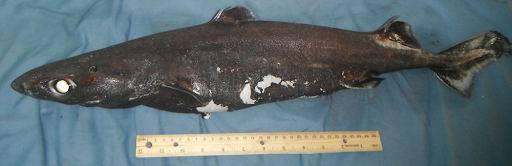
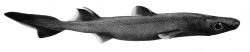
The Southern Lanternshark is a large, heavy-bodied lanternshark with a big head. It has a bladelike uni cuspidate teeth in the lower jaw and teeth with cusps and cusplets in the upper jaw. Its body is stocky like, with conspicuous lines of denticles on the body, conspicuous black markings on the underside of the body and tail. Dark brown or black in colour, and possibly darker below. This species reaches a maximum size of 74.9 cm/2.46 ft TL, and maturity is reached at about 46 cm/18.1 in TL. this species feeds on bony fish, squid, shrimp, and crabs. Its reproduction mode is ovoviviparous with 10-13 pups in a litter. The size at birth is of 18 cm/7.1 in TL.
Habitat:
The Southern Lanternshark is a bathydemersal species found on the outermost continental shelves and upper slopes at depths of 220-1620 m/722 to 5,315 ft. Its distribution ranges from Southeast Pacific and Southwest Atlantic, south of Chile, Argentina and Falkland Islands.
Conservation:
Listed by the IUCN as Least Concern. There are currently no conservation measures in place for this species. The Southern Lanternshark is taken incidentally in benthic trawl and longline artisanal and commercial fisheries throughout its range. At this time, there are no species-specific management actions in place for the Southern Lanternshark, however, fisheries closures and restrictions in the Tasman Sea may indirectly offer this species some refuge, particularly in deeper waters. There is nothing to infer population decline at this time.
This species is not known to be utilized and is generally discarded (Daley et al. 2002, Ebert 2015). However, in New Zealand, there are recent increases in reported, estimated catch (Francis et al. 2016), but it is not known whether this is the result of improved reporting of discarded sharks, or whether there has been an increase in the retention and use of bycatch, perhaps for its liver oil (M.P. Francis, pers. comm. 15/08/17).
Although no species-specific management is in place, some management arrangements in New Zealand and Australia are relevant to this species.
New Zealand has had a Quota Management System (QMS) in place since 1986 to provide for the sustainable management of its fisheries. The Southern Lanternshark is a non-QMS species, meaning that there is no species-specific management in place (MPI 2013). New Zealand has a system of Benthic Protected Areas (BPAs) and Seamount Closures, however they are unlikely to provide any major refuge for this species given the spatial occurrence of the closed areas (see Black and Tilney 2015).
In Australia, a combination of trawling closures in most of the Southern and Eastern Scalefish and Shark Fishery (SESSF) waters deeper than 700 m since 2005, as well as the closure of the South Tasman Rise Fishery in 2007 (Patterson et al. 2016), may indirectly offer this species some refuge in this region. The species may also receive some refuge in closed areas of the Australian Commonwealth Marine Reserve network. Further information is required on the distribution and population trends of the Southern Lanternshark, as well as interactions with fisheries across its range.
Do you have images or videos of Southern Lanternsharks?
Submit them to [email protected].


Donate Now | Team Sharkwater Newsletter | Group Sales | Shark Database | #SharkFree
Contact Us | Press | Partners | Terms of Use | Privacy Policy
© 2026 Sharkwater Productions - The Truth Will Surface 🦈