


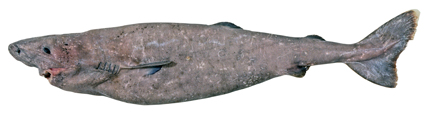
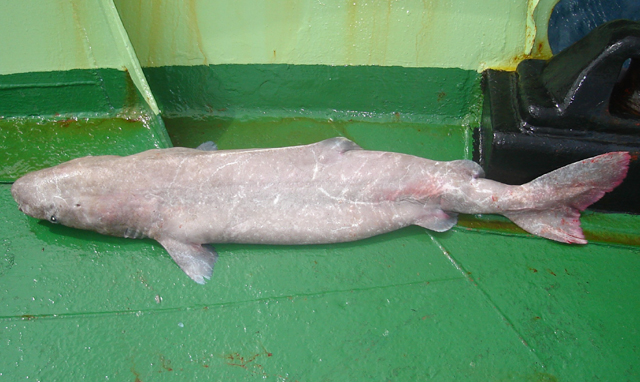
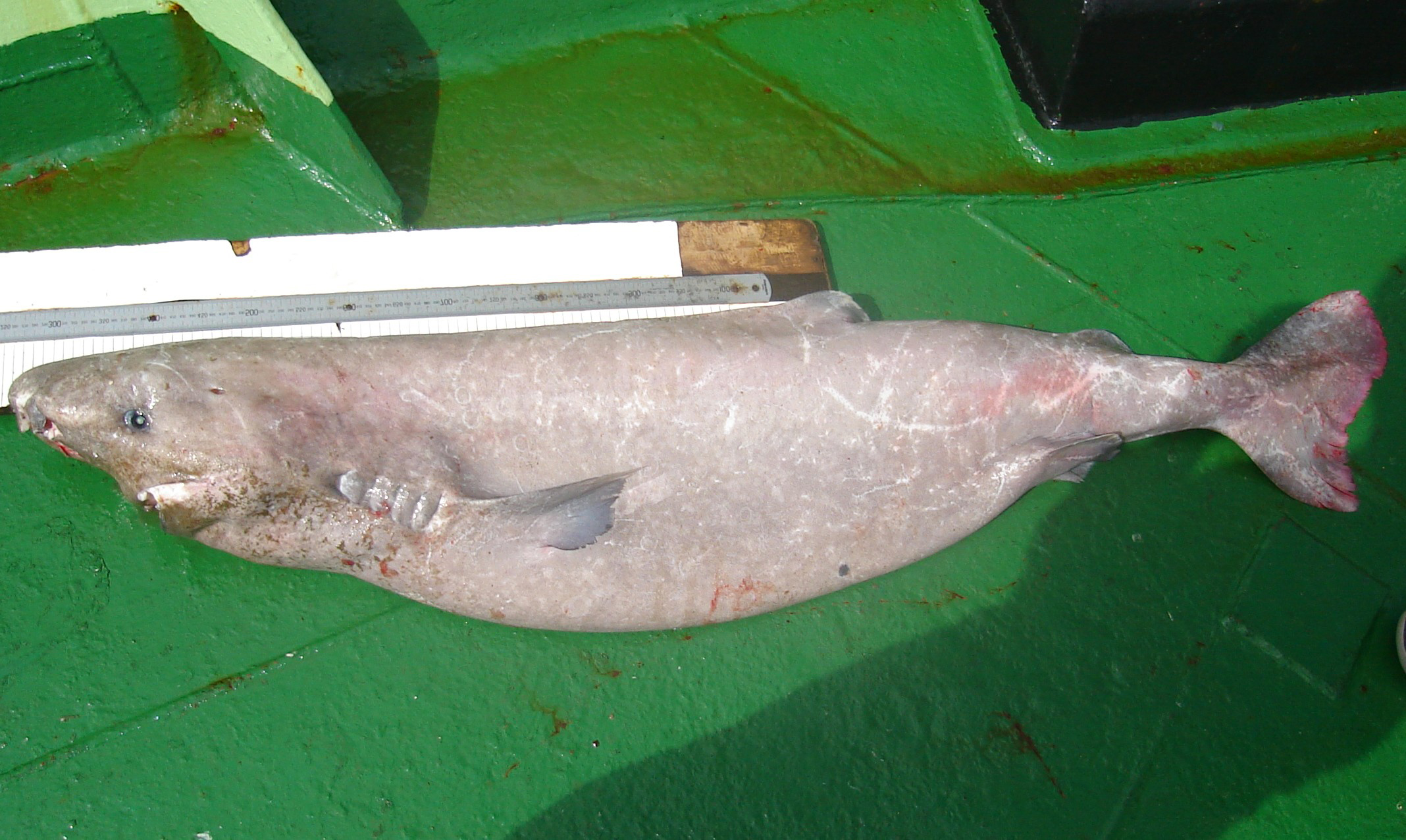
The Somniosus Antarcticus, also known as the Southern Sleeper Shark, Blimp Shark and Whitely’s Sleeper Shark, is a deepwater benthopelagic sleeper shark of the family Somniosidae found in the southern Atlantic, Indian and Pacific oceans.
Biology:
The average size of this species is of 4.4 m (14ft).
Reproduction:
This species is ovoviviparous, meaning they reproduce by developing eggs inside the mother’s body, where the embryos hatch internally and are born as live young, nourished by the egg yolk rather than a placenta, with a size at birth around 40 cm. Litter size, gestation, reproductive cycle, age and growth are unknown.
Habitat:
The Southern Sleeper Shark is native of Australia, New Zealand, Southwest Indian Ocean, southeast and southwest Pacific. Their habitat ranges from near the bottom with current from 400 to 1,100m/1,312–3,609 ft.
Behaviour:
They feed primarily on cephalopods, especially the colossal squid, and fish. Their stomach contents also remain of marine mammals and birds. Based on its generally sluggish nature and speed of its prey, it is thought to be an ambush predator.
Conservation:
This dogfish is sometimes taken as bycatch in the orange roughy and Patagonian toothfish fisheries; whether this poses a threat to the species is currently unknown. Current population size is unknown. The Southern Sleeper Shark is infrequently taken as incidental bycatch in benthic trawl, set net, and longline fisheries across most of its range, including deepwater longline fisheries targeting Patagonian Toothfish (Dissostichus eleginoides). There are species-specific management actions for the Southern Sleeper Shark in Antarctic waters in the form of bycatch move-on rules. Information regarding the species’ biology, population trends, and interactions with fisheries is required, however, its distribution is widespread and there is nothing to infer population decline at this time, thus the Southern Sleeper Shark is assessed as Least Concern.
Further information is required on the distribution, life history, and population trends of the Southern Sleeper Shark, as well as interactions with fishing. There are some management measures for sleeper sharks in Antarctic waters, with some other management arrangements in New Zealand and Australia also relevant to this species.
New Zealand has had a Quota Management System (QMS) in place since 1986 to provide for the sustainable management of its fisheries. The Southern Sleeper Shark is a non-QMS species, meaning that there is no species-specific management in place for the species (MPI 2013). Targeted shark fishing is prohibited within Antarctic waters and bycatch is to be released alive when possible (CCAMLR 2006). For fisheries targeting Patagonian Toothfish (Dissostichus eleginoides) and Mackerel Icefish (Champsocephalus gunnari), if the bycatch of Somniosus spp. of any one haul is equal to or greater than two tonnes, then the fishing vessel is prohibited from using that method of fishing within 5 nm² of the location for a period of at least five days (CCAMLR 2016).
New Zealand has a system of Benthic Protected Areas (BPAs) and Seamount Closures, which may provide some refuge for this species given the spatial occurrence of the closed areas (see Black and Tilney 2015). In Australia, a combination of trawling closures in most of the Southern and Eastern Scalefish and Shark Fishery (SESSF) waters deeper than 700 m since 2005, as well as the closure of the South Tasman Rise Fishery in 2007 (Patterson et al. 2016), may indirectly offer this species some refuge in this region.
Do you have images or videos of Southern Sleeper Sharks?
Submit them to [email protected].


Donate Now | Team Sharkwater Newsletter | Group Sales | Shark Database | #SharkFree
Contact Us | Press | Partners | Terms of Use | Privacy Policy
© 2026 Sharkwater Productions - The Truth Will Surface 🦈