


The Spade-nose Shark is a species of requiem shark, and part of the family Carcharhinidae. It is common in the tropical Indian and Western Pacific Oceans.
Biology and description:
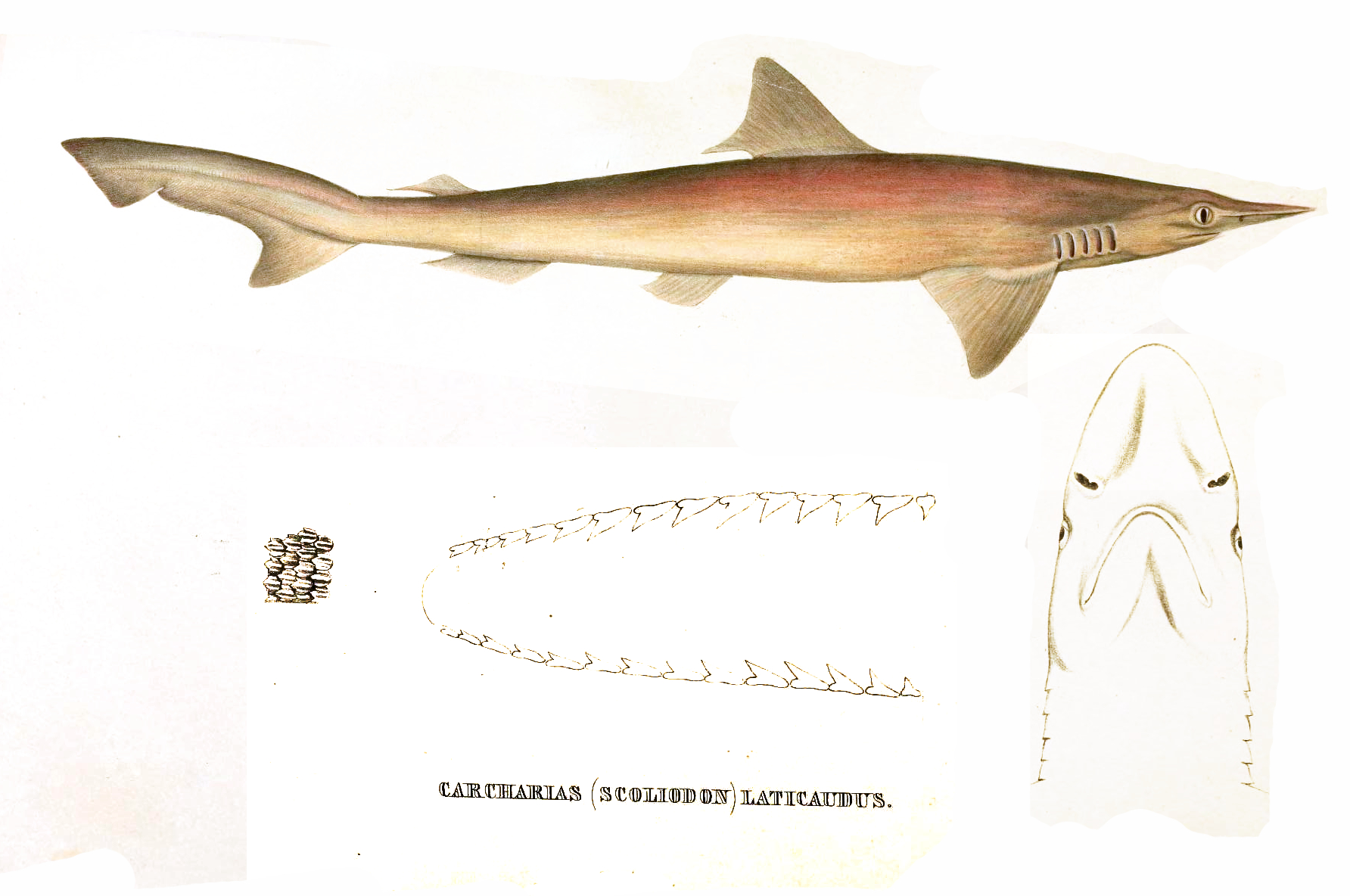
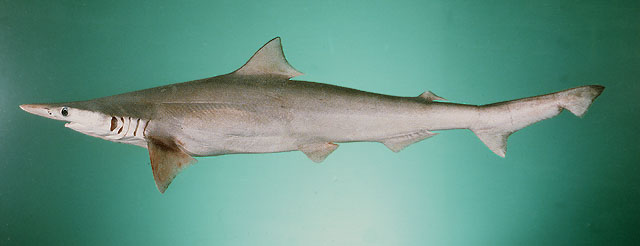
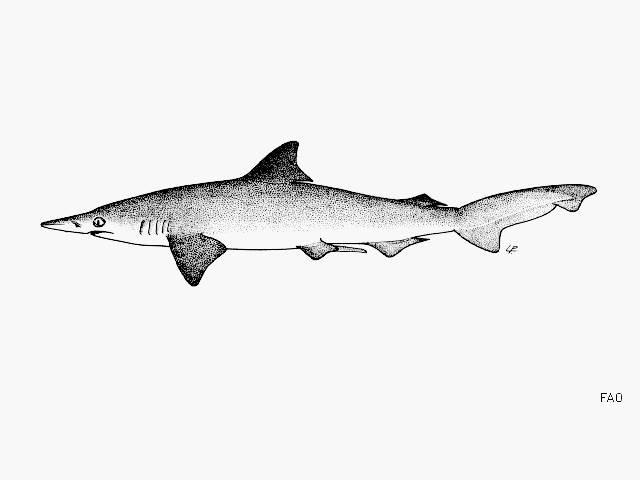
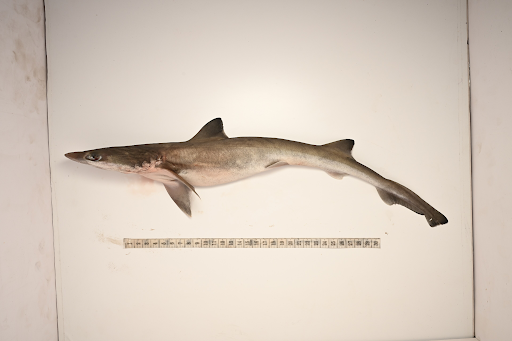
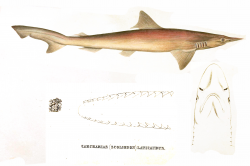
The Spade-nose Shark is a mall, stocky species, has a broad head with a distinctive highly flattened,trowel-shaped snout. The eyes and nares are small. There are 25-33 tooth rows in the upper jaw and 24-34 tooth rows in the lower jaw, each tooth has a single slender, blade-like, oblique cusp without serrations. The first dorsal fin is positioned closer to the pelvic than the pectoral fins, which are very short and broad. The second dorsal fin is much smaller than the anal fin. The back is cover by a bronze-gray color, and the belly is white. The maximum known length of this species ranges from 74 to about 100.0 cm/2.43–3.28 ft TL. The Spadenose is viviparous, with an unusual columnar placenta. Female spadenose sharks probably mate at least once per year, and breeding takes place year-round. The gestation period of the spadenose shark if 5 to 6 months long, and the young are born at a length of 12-15 cm/4.7–5.9 in. The litter size is 6 to 18. Males reach maturity at 24-36 cm/9.4–14.2 in TL, and females at 33-35 cm/13.0–13.8 in TL.
Habitat:
Found in the western Indo-Pacific from Tanzania to South and Southeast Asia. as far as Taiwan and Japan to the north, and as well as Java and Borneo to the east. It typically occurs close to the coast in water 10-13 m/32.8–42.7 ft deep, often close to rocky bottoms.
Conservation:
The abundance of this species in inshore waters makes it a major component of a variety of fisheries in Southeast Asia. Unfortunately, there are no data available on the overall catch of this species, ot the impact of fishing on stocks. There are no known conservation measures in place for this species.
The species is caught mainly by trawl and gillnet in industrial and artisanal fisheries and is retained for human consumption. It is the dominant shark landed in Pakistan, northern India, and Bangladesh and fishing pressure is intense across most of its range. The high productivity of the species and short generation length likely provide it with resilience to fishing pressure, however, the intense and ongoing fishing pressure on this species is a cause for concern. It is suspected that the Spadenose Shark has undergone a population reduction of 20–29% over the past three generation lengths (14 years) and is close to reaching the population reduction threshold due to levels of exploitation, and it is assessed as Near Threatened (nearly meeting Vulnerable A2d). The meat of this species is often sold fresh for human consumption at local markets across the region. In Pakistan and India, the meat is cut into fillets, dried, and salted for domestic sales or trade with neighbouring countries. Fins are not considered valuable due to their small size but are still traded internationally (Jabado et al. 2015b, Cardeñosa et al. 2020).
India and Pakistan have seasonal trawl bans that might benefit the species, however, incidental catches occur in other fisheries (e.g., gillnetting). In India, coastal waters up to 9 km from shore and five to ten fathom depth (at specified areas) are restricted for mechanised fishing in Indian coastal states Gujarat and Maharashtra, where the Spadenose Shark is caught in large quantity (K.V. Akhilesh unpubl. data 2020). Further research is needed on population size and trend, and life history, and catch rates should be monitored.
Do you have images or videos of Spadenose Sharks?
Submit them to [email protected].


Donate Now | Team Sharkwater Newsletter | Group Sales | Shark Database | #SharkFree
Contact Us | Press | Partners | Terms of Use | Privacy Policy
© 2026 Sharkwater Productions - The Truth Will Surface 🦈