


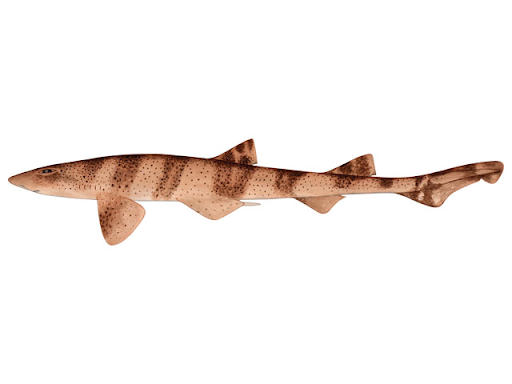
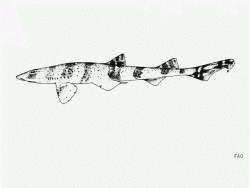
The speckled catshark is a bottom-dwelling shark found in the Western Indian Ocean, around the Gulf of Aden and off the coast of Somalia. It has a depth range of 40 to 250 m/131 to 820 ft. The largest specimen ever recovered was 48 cm/18.9 in long. These sharks have pointed snouts, small mouths, and raised gill slits. They have about 8 saddle-shaped markings on their
Very little is known about their biology, but they’re suspected to be oviparous, with pups being about 7 cm/ 2.8 in at birth.
These species were thought to occur in the Western Pacific as well, but this is now in doubt as there are several similar species that are often mistaken for one another.
Its entire distribution has been subject to at least four decades of unregulated commercial benthic trawling; shelf-occurring catsharks are very susceptible to capture in this fishing gear. The new Somali Fisheries Law bans benthic trawling, but it is suspected that past declines have already occurred given the long history of unregulated fishing across its entire range. Furthermore, enforcement of this new regulation will be a challenge. While specific data are lacking, a population size reduction of 30-50% is suspected over the past three generations (~45 years) based on actual levels of exploitation (bycatch) and the species is assessed as Vulnerable A2d. It is of concern that there have been no records since 1991, although it is acknowledged that research and monitoring have been limited in Somalia. Further investigation of this species is required to accurately define its range, biology, extent of catches in local fisheries and levels of declines. This assessment should be revisited as soon as this is available.
Currently there are no species-specific conservation measures in place. The new Somali Fisheries Law bans benthic trawling (Glaser et al. 2015). Research is required on life history, and its current occurrence across previous trawl grounds. Surveys are needed to further define this species’ distribution and abundance to further assess status and conservation needs.
Do you have images or videos of Speckled Catsharks?
Submit them to [email protected].


Donate Now | Team Sharkwater Newsletter | Group Sales | Shark Database | #SharkFree
Contact Us | Press | Partners | Terms of Use | Privacy Policy
© 2026 Sharkwater Productions - The Truth Will Surface 🦈